

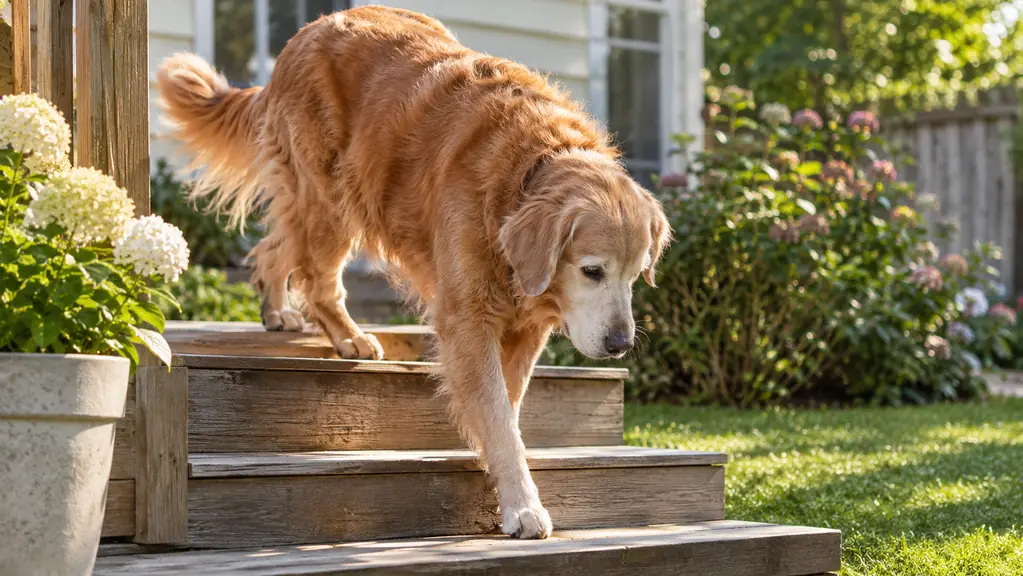
I noticed it first on the back-porch steps. Rusty, our 11-year-old Golden Retriever, would stand at the top, look down at the three steps, and take a breath before committing. Some mornings he would just sit and wait for me to come back and walk him down. That pause is how I knew his hips were bothering him. Our vet recommended Nutramax Cosequin, and after months of daily use, I have some honest thoughts for anyone else watching an old dog slow down.
This is not a story about a dog turning back into a puppy. Rusty is still an old dog. He still naps hard, still takes a minute to get going, and still gives me that look when I reach for the leash on cold mornings. But the morning stiffness that used to have him shuffling to the kitchen is not the same. Here is what I learned, what I would do again, and what I would tell a friend whose dog is starting to slow down.
The Quick Verdict
A solid, vet-recommended joint supplement in a chewable tablet Rusty eats without a fight. It did not cure old age, but it took the edge off his stiff mornings.
Amazon Check Today's Price →The chewable joint supplement our vet recommended first
If your senior dog is stiff after naps or hesitant on the steps, this is the brand our vet suggested before we tried anything else. It is the one we have stuck with for months.
Amazon Check Today's Price on Amazon →How I've Used It
I give Rusty a chewable tablet with his breakfast every morning. The bottle is the 132-count size, so it lasts us a good while. He eats it right out of my hand, which surprised me, because he is picky about pills. Some nights I would forget and give it with dinner instead. It does not seem to matter much, as long as he gets it daily.
The tablet form matters for us. Rusty has never been good at swallowing pills, and the chews we tried earlier ended up under the sofa more than once, usually with a suspicious amount of drool on them. Cosequin comes as a chewable tablet, and it has a smell that he recognizes, so he takes it straight from my fingers instead of sniffing it and walking away. I break it in half sometimes to make it feel like a treat, though I am not sure that is necessary. The point is that he takes it without a fight, which means he actually gets it every day.
I also track how he moves. Every morning, I watch him come down the three back-porch steps. For the first couple of weeks, he would pause at the top, sometimes for a full ten seconds, before putting his front paws down. Now he usually comes down in one steady motion, still careful, but without the hesitation. I keep a little note on my phone with the date and how he did. On October 14th I wrote 'paused, then went slow.' By November 9th the note says 'came down like he used to.' The dates matter because my memory flatters the past. The notes do not. It is not scientific, but it is honest.
We keep the bottle on the counter next to the coffee maker, so I see it every single morning. That is the kind of small system that keeps me honest. If it were in a cabinet, I would forget half the time, and an old dog does not have half a chance to benefit from a supplement he only gets sometimes. Dale teases me about it, but he is also the one who handed me the bottle on the mornings I was moving too fast to notice it.

What's Actually in the Tablet
The active ingredients are glucosamine hydrochloride, MSM, and sodium chondroitin sulfate. Those are the three names I look for in any joint supplement, because they are the ones our vet mentioned when we talked about Rusty's hips. The label lists glucosamine hydrochloride as FCHG49 and sodium chondroitin sulfate as TRH122, which is the kind of specific detail that tells me the company is not being vague about what is inside.
Nutramax has been making pet supplements for more than 25 years, and Cosequin is the brand our vet said she stocks in her own clinic. That matters to me. I have bought enough supplements online to know that some brands change their formula without changing the label. With Nutramax, I can look at the ingredients and recognize every one of them.
The label says it is for joint health, and the bottle lists it for small, average, and large dogs. Rusty is a big Golden, about 70 pounds, and he is on the large end of that range. I like that the same bottle works across sizes, because it means the company is thinking about dogs like mine, not just tiny lap dogs.
What Changed Over Six Months
The honest answer is that the change was gradual. I did not see a different dog in the first week. What I saw, around the third week, was that Rusty stopped doing the little pre-step shuffle at the top of the porch. He would just go. By the second month, he was trotting to the car again, not walking like he was saving his joints for later.
I want to be careful here. Rusty still has stiff mornings. Some days, especially after a cold night, he gets up and walks like a dog twice his age for the first few minutes. The difference is that the stiffness does not last as long. He shakes it off faster. The walk we do every morning used to start with ten minutes of slow shuffling, him stopping to smell the same bush twice while he warmed up. Now he is ready to actually walk after about five. On the coldest morning we had in January, 28 degrees, he still took his time. But by the time we reached the corner, he was pulling on the leash the way he does when he is happy.
I also noticed it on the hardwood floors. Our house is one story, but the floors are slick, and Rusty has always been cautious on them. He still is, but he does not do the wide-legged wobble he used to do first thing in the morning, the one where his back feet slid out from under him before he got his balance. I cannot prove the supplement did that by itself. We also put down a couple of runners last fall, and I am sure they helped. But the timing matched, and I am not going to pretend I did not notice.
The morning after the first few weeks, Rusty came down the porch steps without the little pause he used to take. That was the moment I stopped wondering whether the tablets were worth it.
How It Compares to the Chews I Tried First
Before Cosequin, I tried a soft glucosamine chew that Rusty loved a little too much. He would eat the whole bag if I let him, and he treated it like a treat, which meant he did not always get it on the days I needed it to last. One afternoon I found him on the kitchen rug with the empty bag, and that was the end of that experiment. The chewable tablet from Nutramax is less exciting to him, which is actually a good thing. He takes it because I hand it to him, not because he is begging for candy.
I also looked at powders you mix into food. The problem for us was that Rusty is a picky eater, and the powder changed the smell of his breakfast enough that he would sometimes walk away. The tablet does not have that problem. It goes in his mouth before the food, so the food stays exactly the way he likes it.
The other thing I appreciate is that the tablets are easy to store and travel with. When we visit family for Thanksgiving, I can toss the bottle in a bag without worrying about powder spilling or chews going stale. This year I packed it in the side pocket of my overnight bag on a Thursday night, and it came out on Monday morning looking exactly the same. It is a small thing, but with an old dog, the small things are the whole job.
I will be honest that the first bottle I bought is not empty yet, so I cannot tell you exactly how many weeks it lasts. What I can tell you is that I have not thought about switching, and for me that is the highest compliment a product can get.
What I Wish I'd Known at the Start
I wish I had started taking notes sooner. For the first few weeks, I relied on my memory, and my memory is not as good as it used to be. Once I started writing down how Rusty did on the steps each morning, I could see a pattern that I would have missed otherwise. The change was not dramatic on any single day. It was the kind of slow improvement that only shows up when you look back at a month of notes. My note from the second week says 'still pausing.' The one from week six says 'barely slowed down.' Same dog, same steps, different story.
I also wish I had not expected a quick fix. Supplements are not like pain medicine. You do not give one and watch the dog bounce. You give it every day, for weeks, and then one morning you realize the dog did not pause at the top of the steps. That is the realistic version. If you want a product that works overnight, you will be disappointed, and that disappointment is not the product's fault.
And I wish I had asked the vet more questions at the start. Our vet was the one who recommended Cosequin, but I did not ask her how long to try it or what to watch for. In hindsight, I would have asked those things. If you are reading this and your dog is stiff, write down your questions before you call the vet. It is the kind of thing you think you will remember and then do not.
After months of daily use, here is my honest bottom line. Cosequin did not turn Rusty into a young dog, and I did not expect it to. It made his stiff mornings easier, it gave him back a little of his old confidence on the steps, and it was easy enough to give him every day that we actually stuck with it. On the mornings when he comes down the steps without pausing, I do not have to wonder whether it is working. That is a good outcome for a supplement, and it is the reason I would buy it again.
What I Liked
- Chewable tablet that Rusty takes without a fight
- Active ingredients are the ones our vet named: glucosamine, MSM, and chondroitin
- 132-count bottle lasts a long time
- Brand with 25-plus years in pet health and a presence in vet clinics
- Easy to store and travel with
Where It Falls Short
- It is a supplement, not a cure. Rusty still has stiff mornings
- The tablets are not treats, so you have to be consistent about giving them
- Some dogs may not like the taste; we got lucky
- Check with your vet before starting, especially with a diagnosed condition
Who This Is For
Owners of senior dogs who are still mobile but stiff. If your dog hesitates at the steps, shuffles on hard floors, or takes a while to warm up on walks, Cosequin is a reasonable thing to try. It is also for people like me who want a supplement that is easy to give every day and easy to track. If you are already doing the other basics, good food, gentle exercise, a soft bed, sure footing, this fits alongside all of that.
I would also say this is for owners who can be consistent. A supplement only works if the dog actually gets it, day after day. If you are the kind of person who will forget by Thursday, set a phone reminder or keep the bottle next to the food bowl. That sounds silly, but it is the difference between a fair trial and a waste of money.
It is also for people who have already tried the obvious things, a softer bed, a ramp, shorter walks, and still see their dog hesitate. Cosequin is not the first thing I would change, but it is a reasonable next step after the basics are in place.
Who Should Skip It
Dogs with a known joint injury or a condition your vet is already treating. I am not a vet, and I would never tell you to replace veterinary care with a supplement. If your dog is in real pain, limping, or not putting weight on a leg, go see your vet first. Also, if your dog refuses to take tablets no matter what you do, you will end up fighting every day, and that is not good for either of you. Talk to your vet about whether Cosequin makes sense for your dog, and if it does, give it a fair trial of a few weeks before you judge it.
And if your dog is already on another joint supplement, talk to your vet before switching or stacking. I am not a vet, and I do not know how different products interact. The safest thing is to ask. That is the same advice I would give anyone I care about, and it is the advice I would want someone to give me.
Try it the way we did: one bottle, a few weeks, and a note on your phone
You do not have to take my word for it. Check today's price on Amazon, talk to your vet, and give it a fair trial. That is the only way to know if it helps your dog.
Amazon Check Today's Price on Amazon →