
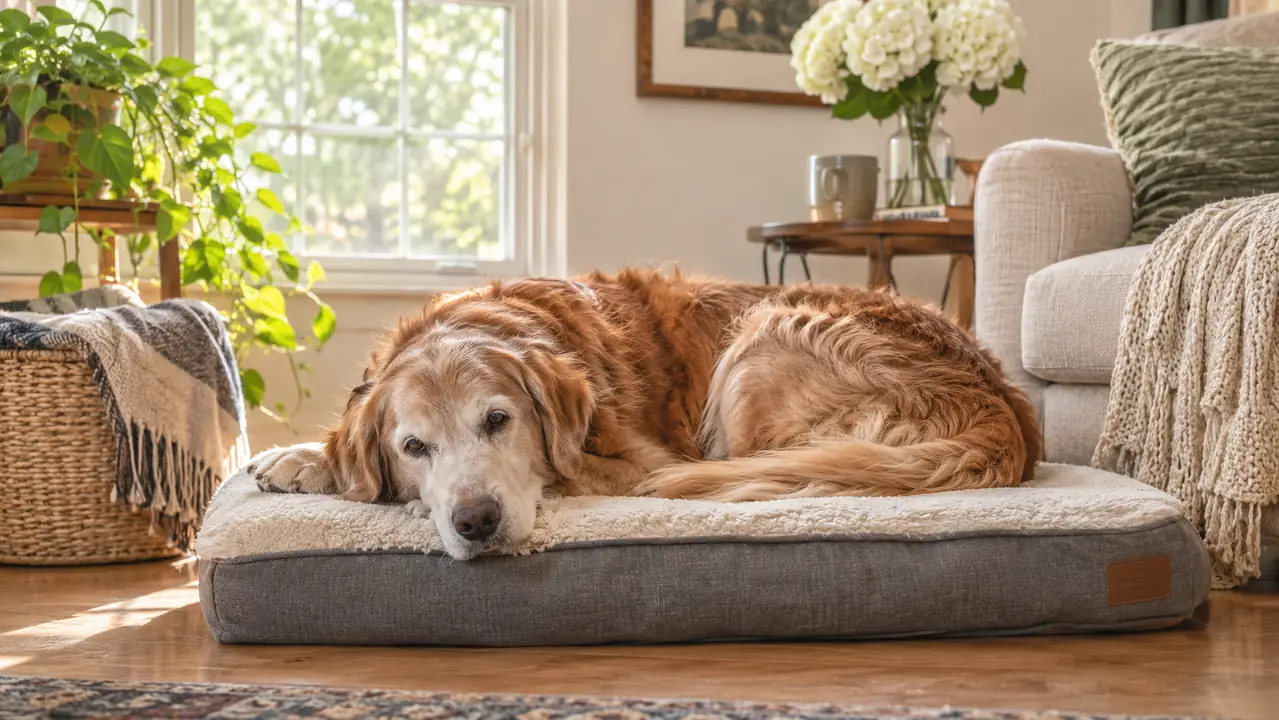
I bought the Bedsure Orthopedic Dog Bed for Rusty, our 11-year-old Golden Retriever, about four months ago. He is roughly 70 pounds, stiff in the back hips after a nap, and slow on the three steps down to the backyard. I wanted a bed that would give him a firm, flat place to stretch out on our hardwood floors. What I got was a bed that taught me a few things about what "orthopedic" does and does not mean, and I think owners of senior dogs deserve the honest version before they click buy.
Here is what nobody tells you up front: the Bedsure Orthopedic Dog Bed is a good bed for a specific kind of dog, and it is not the right bed for every senior dog. It is large, washable, and built with a bolsters-on-four-sides design that some dogs love and some dogs ignore. Whether it works for yours depends on how your dog sleeps, how they get up, and how much support they actually need.
The Quick Verdict
A roomy, washable, honestly supportive bed for senior dogs who like to stretch out with their head on a bolster. Not ideal for dogs who need a low, flat surface to climb onto.
Amazon Check Today's Price →The bed that finally got Rusty to stop flopping onto the hardwood
After months of daily use, the Bedsure Orthopedic Dog Bed is the one we keep in the living room. It gives a stiff 70-pound dog a firm, supported place to rest, and the removable cover makes it practical.
Amazon Check Today's Price on Amazon →How I've Used It
Rusty has slept on this bed every night since it arrived. During the day he uses it for his long after-walk naps, usually two to three hours at a stretch. I keep it in the living room on a hardwood floor, which is exactly the situation it was bought for. Before this bed, he would lie on the floor and you could see him shift and resettle for a full minute before he found a position that worked. Now he walks onto the bed, turns around once, and drops.
The bed arrived on a Tuesday in early March, and I remember the date because of what happened that same afternoon. Rusty had taken his usual post-walk nap on the bare floor, and when he tried to get up, he did that slow rock-and-roll thing where he lifts his front end first and then pauses before committing his back legs. That evening I put the new bed in its spot in the living room, and within ten minutes he had claimed it. He walked a full circle around it, sniffed the corner, then stepped on and settled in. I stood there watching, half expecting him to get up and move back to the floor where he had slept for years. He did not. He has slept on it every night since.
The bed measures 35 x 7 x 25 inches and weighs about 5.34 pounds, which makes it easy for me to lift and move when I vacuum. The 7-inch height is the middle ground I was looking for: enough cushion that his hips are not pressed against the floor, but not so tall that a stiff dog has to climb. Rusty is about 70 pounds, and the listed maximum weight recommendation is 30 pounds. That number confused me at first, so let me explain what I think it means and how I decided it was not a dealbreaker.
The 30-pound figure appears to be a conservative engineering limit for the foam core, not a real-world limit for how a dog lies on the bed. A 70-pound dog spreads his weight across the whole surface. He does not stand on it with all his weight on one point. I watched Rusty closely for the first two weeks, checking whether the foam bottomed out under his hips. It did not. The foam compressed a little, the way any foam will, but he stayed supported and he stopped doing the pre-sleep shuffle. I am not a vet, so if your dog has a diagnosed joint condition, please check with your veterinarian before changing anything about their routine.
What the Bolster Design Actually Does
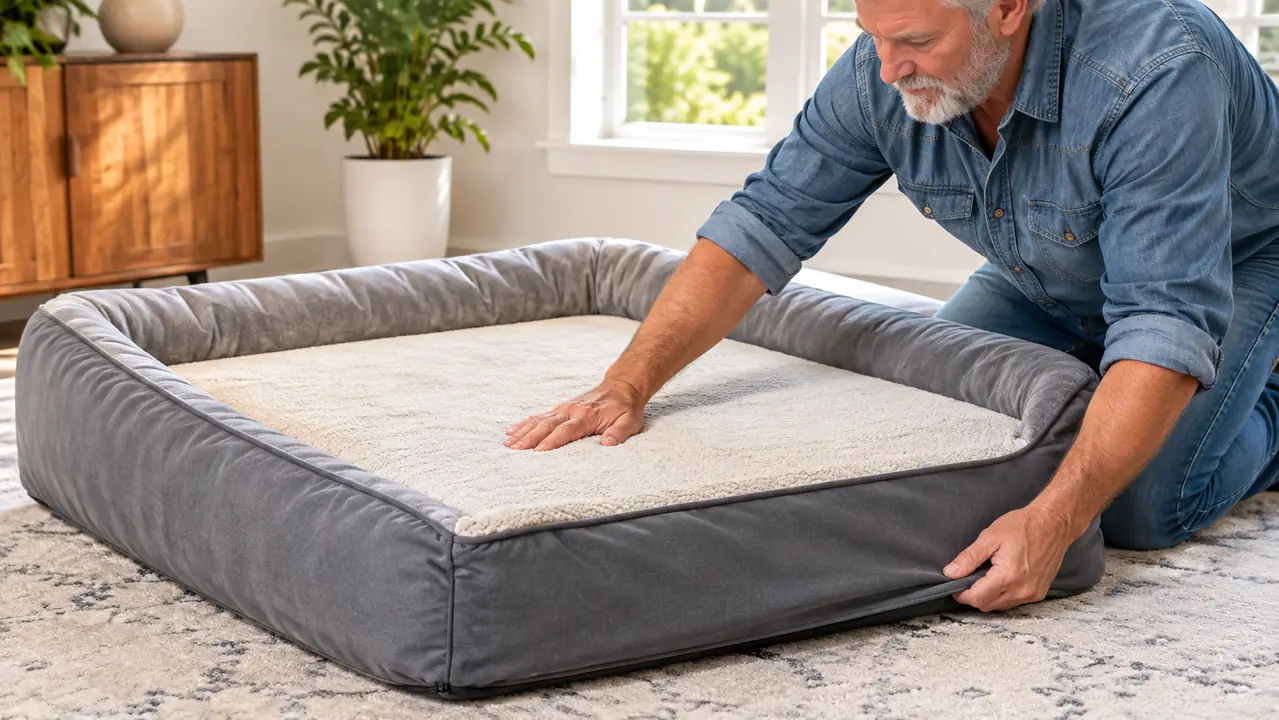
The most talked-about feature of this bed is the 4-sided bolster design. That means there is a raised edge on all four sides, not just two. For Rusty, the side bolsters are the best part. He is a dog who likes to rest his head on something when he sleeps, and the raised edge gives him exactly that. He tucks his muzzle over the bolster and his neck stays in a neutral position. I did not expect a bed to change how he positions his head, but it did.
The first time I really understood the bolster design was a Saturday morning in April. Dale was still asleep, Rusty and I had come back from our walk, and I watched him from the kitchen while I made coffee. Instead of flopping down in the middle of the bed the way he used to flop on the floor, he walked to the far end, tucked his muzzle over the back bolster, and let out a sigh I could hear across the room. His neck sat level with his spine, not twisted the way it used to be when he slept on the flat floor with his head propped against the leg of the coffee table. That coffee-table habit was something I had never really noticed until it was gone. He had been using a piece of furniture as a pillow for years, and I had no idea.
The front bolster is where I have mixed feelings. It is low enough that Rusty can step over it, and he does, every single time. But I can see how a dog with less mobility or more pain would struggle with even a low edge. If your dog has trouble lifting their back legs, a 7-inch bed with a raised front lip is going to be an obstacle, not a comfort. That is the honest tradeoff of the bolster design, and it is the main reason I tell people to think about how their dog gets on and off a bed before they buy this one.
Rusty stopped doing the pre-sleep shuffle the first week. That is the moment I knew the bed was doing something real.
The Washable Cover Is the Feature That Keeps It Practical
The removable cover is listed as easy to clean, and in my experience that is the truth. The cover zips off completely, and I wash it every other week. Rusty is 11 and he has the occasional accident, especially on nights when he drinks a lot of water before bed. With the old bed, an accident meant the whole bed was ruined. With this one, I unzip the cover, wash it, and the bed is back in service the same day.
The bed also lists waterproof as a special feature, and I want to be precise about what that has meant for us. The cover has held up to accidents without anything soaking through to the foam. I have not tested it by pouring water on it, because that is not how a bed gets used in our house. What I can tell you is that after four months and several wash cycles, the cover still fits snugly, the zipper still works, and the foam core still holds its shape. That is the practical version of waterproof that matters to an owner of a senior dog.
The real test came on a rainy night in late April. Rusty drank more water than usual before bed, and at about 2 in the morning I heard him get up, which he almost never does. He had an accident on the bed, and I will not pretend I was cheerful at 2 a.m. I pulled the cover off right there in the dark, carried it to the laundry room, and went back to bed. The next morning I washed it on a normal cycle with the same detergent I use for our sheets, dried it on low, and had it back on the bed before dinner. The foam underneath was dry. Not damp, not spotted, dry. That was the moment I stopped worrying about whether the waterproof claim would hold up. It had already been tested by the messiest possible real-world situation, and it passed.
One honest note on washing: the cover is large, and it takes a full dryer cycle to dry. I wash it on a normal cycle and hang it to finish drying, and I plan for the bed to be out of service for part of a day. That is not a complaint, it is just the reality of owning a washable bed. If you only have one bed and your dog absolutely needs it every night, buy a second cover or plan your wash day.
Foam, Materials, and the Certifications That Actually Matter
The Bedsure bed is made with CertiPUR-US certified foam, and the cover is Standard 100 by OEKO-TEX certified. I will be honest: before I bought this bed, I did not know what either of those certifications meant. Now I do, and they matter more to me than any marketing word on the box.
CertiPUR-US means the foam was tested for emissions and content, so it should not contain the harsh chemicals that cheap foam sometimes does. The OEKO-TEX certification on the cover means the fabric was tested for harmful substances. For a dog who spends a third of his life with his nose pressed into a bed, those certifications are the difference between a bed I feel good about and a bed I would worry about. The bed is also listed as environmentally friendly and made with pet safe materials, which tracks with what I smelled, or more accurately, what I did not smell. There was no strong off-gassing odor when we opened it, just a mild new-foam smell that faded within a day.
The Honest Cons Nobody Puts in the Product Photos
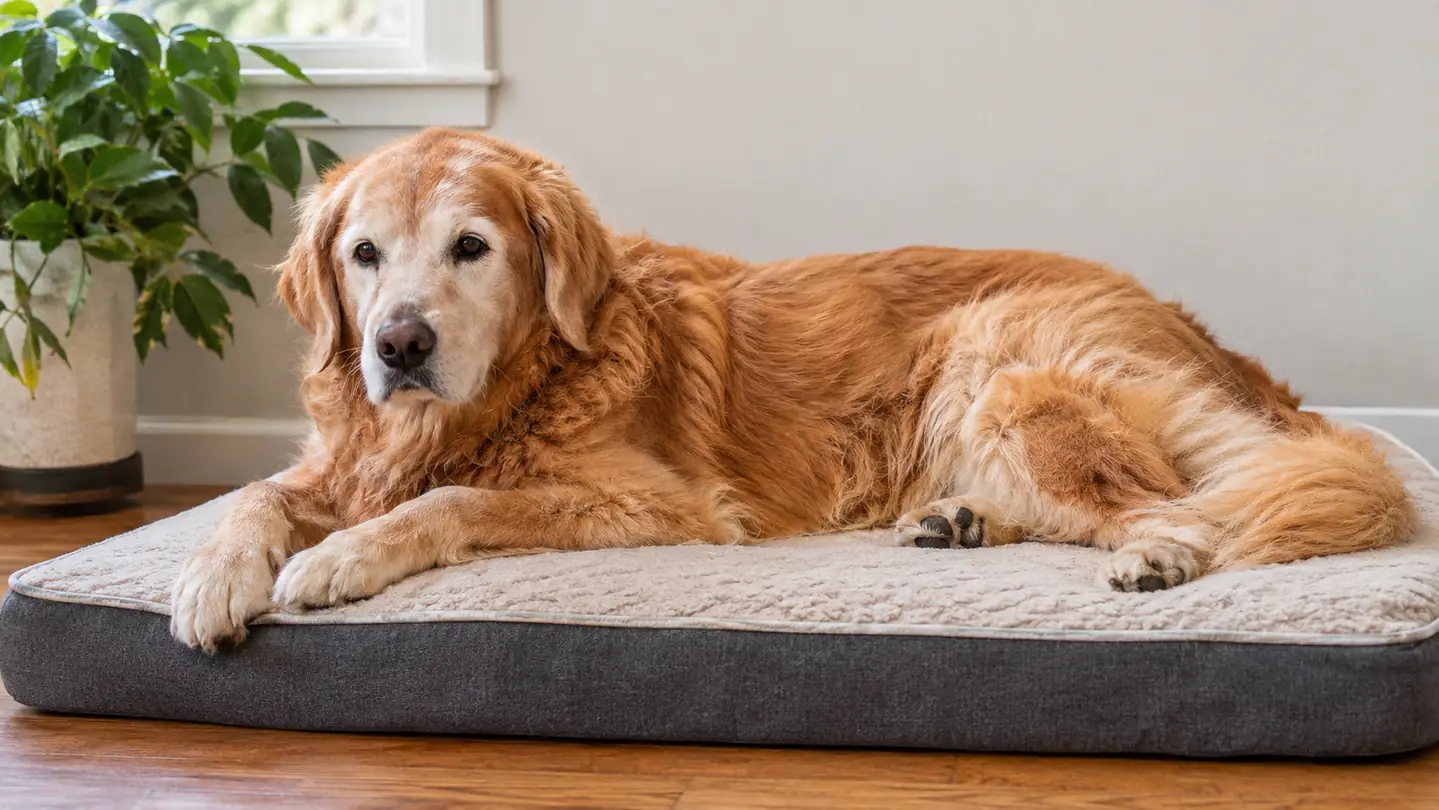
First, the front bolster. I have already talked about it, but it deserves to be on the con list. A raised edge on all four sides is great for head support and terrible for a dog who needs to step onto the bed without lifting their feet high. Rusty manages fine. A smaller dog, an arthritic dog, or a dog recovering from surgery might not.
The front bolster gave me my one genuine scare with this bed about six weeks in. Rusty came in from the backyard one afternoon, tired and wet from the rain, and instead of stepping over the front edge the way he always does, he tried to step onto the middle of the bed from the side. His back foot caught the edge of the bolster and he stumbled for a half second before catching himself. He was fine, and he has never repeated it, but I watched that moment closely. It reminded me that a raised edge is a raised edge, no matter how low it looks. For a dog with less strength in his back legs than Rusty has, that stumble could be a fall. I would not put this bed in a house with a dog who cannot clear that edge reliably.
Second, the listed maximum weight recommendation of 30 pounds does not match the "Large" breed recommendation. That mismatch is confusing, and Bedsure does not explain it in the listing. I made a judgment call for my 70-pound dog based on how he actually lies on the bed, and it has worked out. But I understand why an owner would look at that 30-pound number and move on, and I would not blame them.
Third, the bed is a single solid piece. There is no way to wash just the top surface without taking the whole cover off, and there is no second cover included. If your dog has frequent accidents, you will want a backup plan.
Fourth, and this one surprised me: some dogs simply do not use a bolster bed. I have heard from other owners whose dogs sleep in the middle of the floor, flat on their side, ignoring the bolsters entirely. If your dog does not rest their head on things, you are paying for a design feature they will never use. That is not a flaw in the bed, but it is a reason to think about your specific dog before you buy.
What I Liked
- Firm, supportive foam that held up under a 70-pound dog for four months
- Removable, machine-washable cover that survived repeated wash cycles
- 4-sided bolster gives head and neck support for dogs who like to rest their head
- CertiPUR-US certified foam and OEKO-TEX certified cover
- Light enough at 5.34 pounds to lift and move easily
- No strong off-gassing smell out of the box
Where It Falls Short
- Front bolster can be a hurdle for dogs with limited mobility
- Listed 30-pound maximum weight recommendation conflicts with the Large size
- Single-piece design means the whole cover comes off for every wash
- Bolster design is wasted on dogs who sleep flat and never rest their head
How It Compares to the Alternatives I Considered
Before I settled on the Bedsure, I looked at two other kinds of beds. The first was a flat foam mat with no bolsters. It was cheaper, and I can see the appeal, but Rusty immediately proved he wanted something to rest his head on. The flat mat would have been the wrong purchase for him. The second was a much taller bed with a thick step-up edge. That one would have been too tall for a dog who already struggles with the back-porch steps. The Bedsure's 7-inch height is the middle ground that actually works for him.
I also considered whether we needed a bed with a heating element or a memory foam topper. Rusty's stiffness is in his hips, and our vet has not recommended heat for him, so I did not see a reason to pay for features he would not use. The Bedsure is a straightforward orthopedic bed, and for our situation, straightforward was the right call. As always, check with your veterinarian before making changes for a dog with a diagnosed condition.
Who This Is For
This bed is for owners of senior dogs who like to stretch out and rest their head on something. It is for dogs who are still mobile enough to step over a low edge, and for owners who want a bed that can be washed after the inevitable accident. It is for people who care about what their dog's bed is made of and who want the reassurance of independent foam and fabric certifications. If that sounds like your situation, the Bedsure Orthopedic Dog Bed is worth a serious look.
Who Should Skip It
Skip this bed if your dog has trouble lifting their back legs or cannot reliably step over even a low edge. Skip it if your dog sleeps flat on their side and never uses a pillow or a head rest. Skip it if you need a bed that can be wiped down without removing the cover, because the whole cover has to come off for cleaning. And if you have a very large dog, read the 30-pound maximum weight recommendation and decide for yourself whether you are comfortable with it. I was, for Rusty, but it is a number you should see before you buy, not after.
The honest bottom line from four months of daily use
The Bedsure Orthopedic Dog Bed is not perfect, but it solved the problem I bought it for. Rusty sleeps better, rests his head where he wants it, and I can wash the cover when he has an accident. If that matches what you need, it is worth today's price.
Amazon Check Today's Price on Amazon →