
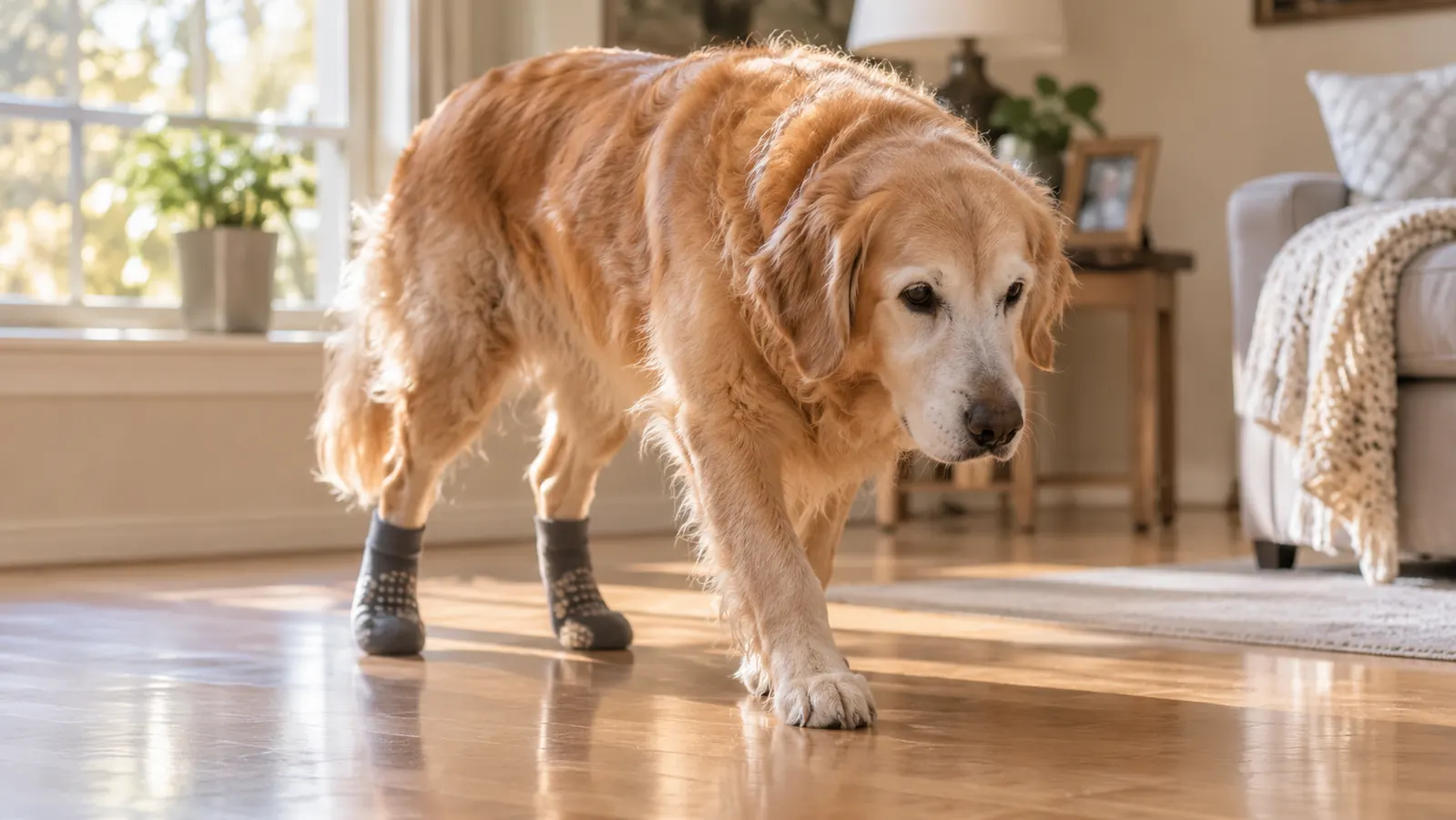
Rusty turned 11 in March, and somewhere between the birthday cookie and the spring allergy season, I started watching his feet more than his eyes. On our hardwood and tile floors, his back paws would slide out from under him when he stood up from a nap. Not a fall, not yet, just that little skate-and-catch that makes your stomach drop. I have had dogs my whole life, and I have learned that an older dog, like an older person, does best with sure footing, a good bed, and patience. Slippery floors are the enemy of all three. I tried rugs in the worst spots, and they helped, until they bunched up. I tried trimming the fur between his toes, and that helped a little too. Then a friend whose Lab has the same problem handed me a pair of DOK TigerToes dog socks and told me to stop overthinking it. Six months later I have opinions, and a few of them are not the ones you will read in the listing.
The Quick Verdict
Genuinely useful for an older dog on slick floors, but the fit is fiddly, the sizing window is narrow, and they are not a substitute for a rug or a vet visit.
Amazon Check Today's Price →The socks that keep a stiff old dog from skating on hardwood
DOK TigerToes come four to a pack, machine washable, with a hook-and-loop closure that stays put better than any pull-on sock I tried. If your dog's back feet slide on tile, this is the pair to start with.
Amazon Check Today's Price on Amazon →How I've Used Them
I want to be clear about what this review is and what it is not. It is one 64-year-old woman's experience with one 70-pound Golden Retriever on one set of floors in Plano, Texas. It is not a laboratory test, and I am not a veterinarian. Rusty does not have a diagnosed joint condition, but he is stiff in the back hips after naps and he takes the three back-porch steps like they are made of ice. I mentioned the socks to our vet at his checkup, and she said sure footing is one of the kindest things you can give an older dog, as long as the socks do not stay on around the clock. That is the dog these socks were tested on.
Our routine has not changed since I started using them. Every morning, Rusty and I do a 20 to 30 minute walk on the sidewalk loop, then he comes inside, gets a drink, and parks himself on the kitchen tile like a furry speed bump. The socks go on before his nap and come off for the night. I wash them in the machine on cold with the rest of his bedding and hang them to dry. That has been the whole protocol, and I kept it deliberately simple so I could judge the socks on their own.
The listing says the large size fits paws 2.5 to 2.8 inches and includes four socks, which matters more than it sounds like it should. Two of the four are the ones that stay on the back feet, and the other two give you a spare when one goes through the wash or gets lost under the couch. With a single pair, you would be doing laundry every other day, and a dog who is waiting at the door does not care about your laundry schedule.
Fit: The Part Nobody Warns You About
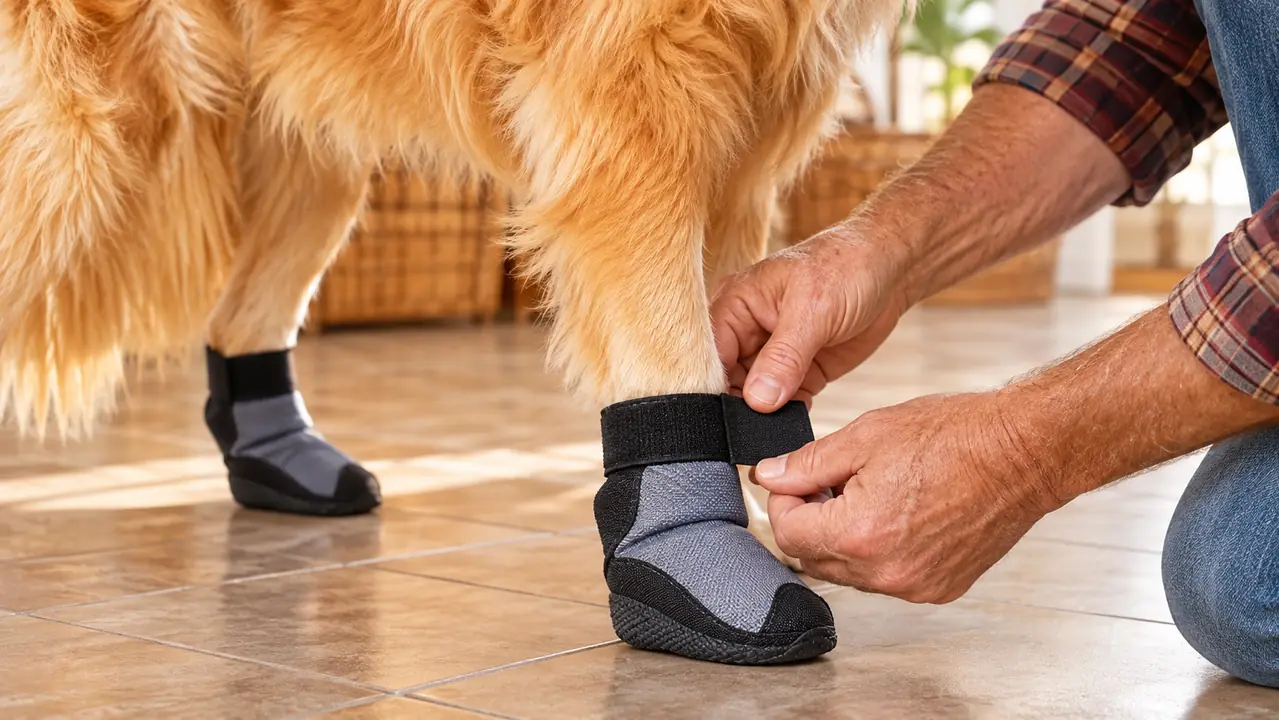
Here is what nobody tells you: getting these on a senior dog is a two-person job the first few times. Rusty is not a puppy, and he does not like having his paws handled. The sock has a hook-and-loop closure, which is exactly what makes it stay on, but it also means you have to open the strap, guide his toes in, and then snug the strap around his ankle while he is trying to sit down. The first week, Dale held the treat and I did the fitting. By the second week, Rusty figured out that the treat appears after the socks, and now he stands still for it, which I did not expect from an 11-year-old who has opinions about everything.
The sizing window is narrow, and it is the single most important detail in the listing. Large fits paws 2.5 to 2.8 inches. Rusty's front paws measure about 2.7, and his back paws are a hair narrower, so the large is right for him. If your dog's paw is bigger than 2.8, these will feel tight across the toes, and a sock that is tight across the toes is a sock your dog will spend the whole day trying to remove. Measure before you order, and measure the back paws, because those are the ones doing the sliding.
Once they are on, they stay on, and that is the part that surprised me. The material is a cotton and nylon blend, so it has a little stretch but not so much that it bags at the ankle. The hook-and-loop closure lets you set the tension instead of hoping the elastic does the job. Rusty has kicked at these socks exactly twice, both times in the first week, and both times I had the strap too loose. Once I learned to snug it, the socks stopped being a battle.
Grip on Hardwood and Tile
The whole point of these socks is traction, so let me tell you what the grip actually did on our floors. Before the socks, Rusty's back feet would slide a couple of inches when he stood up from a nap on the tile. After the socks, that slide is gone. He still stands up slowly, because he is an 11-year-old dog with stiff hips, but his feet stay planted while he does it. That is the difference between a dog who is old and a dog who is afraid to move. For a senior dog, keeping the confidence to move is half the battle.
The listing claims 3x more grip, and I cannot verify the math, but I can tell you the direction is right. The grip is aggressive enough that you can feel it when you rub your palm across it. On our hardwood, Rusty walks with his normal gait. On the tile in the kitchen, he does not do the little skate-and-catch anymore. The change was noticeable within the first week, and it has stayed consistent since.
One honest caveat: the grip works best on bare floors. On the area rug in the living room, the socks actually make him a little less sure-footed, because the grip grabs the rug fibers and his foot can catch mid-stride. So we take them off when he is on the rug for a long time, and that is fine, because the rug is the one surface he never slid on anyway. If your house is wall to wall carpet, you probably do not need these socks at all.
What a Typical Morning Looks Like Now
By month three, the socks became as routine as his leash. Here is what a morning looks like now. Rusty wakes up on his bed in the corner of the living room, stretches his front legs out in that long bow, and then stands there for a second while his back hips wake up. On the old floors, that was the exact moment his feet would slide. Now Dale or I fit the back socks on before he walks to the kitchen, and he pads across the tile like it is carpet.
The walk itself is the same 20 to 30 minutes it has always been, and the socks do not change his gait on the sidewalk, which is what I wanted. On the way back, he stops at the three back-porch steps, the ones he takes slowly. The socks do not help with steps, and I want to be honest about that. They are a floor product. For the steps, we still use the same slow, careful routine we have used for a year, and I hold the door and let him take them at his own pace.
After the walk, the socks come off for a few hours while he naps on the rug, because the grip catches on the rug fibers and I would rather he be comfortable. They go back on in the late afternoon, when the light is low and the floors feel slicker to him. That rhythm, on and off, is a small thing to trade for a dog who no longer does the skate-and-catch. It also means the socks get washed often, which is why the machine-wash care instruction matters more than it sounds.
Durability After Months of Walks and Washes
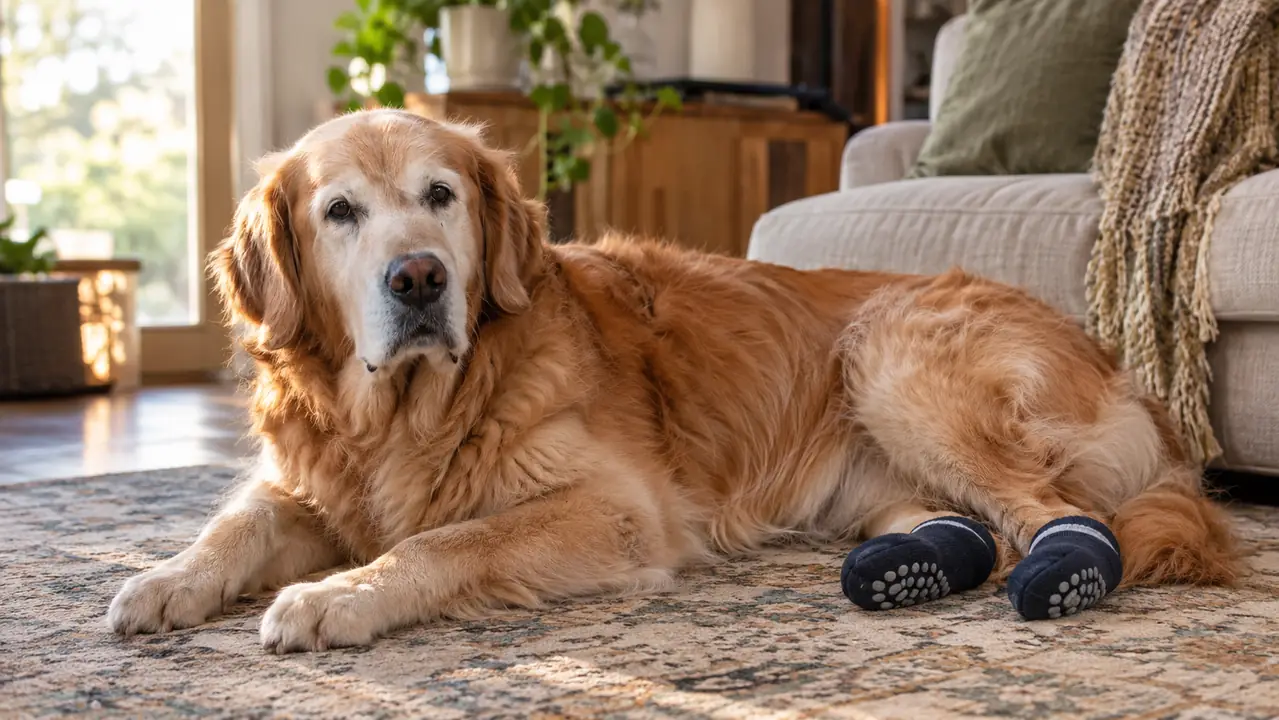
I have washed these socks more times than I can count, and the honest report is mixed. The grip is still there, which surprised me, because I expected it to flatten out after the first few washes. It has not. The cotton and nylon blend has held its shape, and the hook-and-loop strap still closes firmly. No loose threads, no holes at the heel. For a four-pack that gets this much use, that is better durability than I expected.
The thing that has worn down is the inside of the sock where Rusty's dewclaw rubs. He has a slightly overgrown nail on one back foot, and over a few months it has worn a thin spot in the fabric. Not a hole, not yet, but I can see it when I hold the sock up to the light. If your dog has a nail that catches, you will want to keep it trimmed or expect to replace the socks sooner. That is not a flaw in the sock; it is a fact of living with a dog who hates having his nails done.
I also want to be honest about the outdoor claim. The listing says the socks are suitable for indoor and outdoor protection, and we have worn them on the back porch and the first few feet of the walk. They are fine for a quick trip outside, and they give the paw more protection than bare pads on warm concrete. But they are socks, not boots. On wet grass or mud, they soak through, and a wet sock on a senior dog is a sock you will be taking off at the door. I keep a spare pair on the hook for exactly that reason.
The Trade-Offs Nobody Puts in the Listing
If I had to sum up the honest version of this review in one sentence, it would be this: DOK TigerToes are the best solution I found for Rusty's slippery-floor problem, and they are still a workaround, not a cure. They do not fix the stiffness in his hips. They do not replace a good rug in the spots he actually walks. They just make the floor less dangerous, and for a dog his age, that is a real thing. I would buy them again tomorrow, and I would also tell you to keep your expectations at floor level.
Before I settled on these, I tried the obvious things. Rugs in the worst spots, which worked until they bunched into a tripping hazard. Paw fur trims, which helped a little and grew back in two weeks. A pull-on sock from another brand, which Rusty shook off before he made it to the kitchen. The DOK socks were the first thing that stayed on through a full nap and a full walk, and the hook-and-loop closure is the reason why. The closure is the feature that separates these from the pull-on options.
The other trade-off is the daily routine. Some days I do not want to spend two minutes fitting socks onto a dog who is already waiting at the door for his walk. On those days I remind myself that two minutes of fitting beats one emergency trip to the vet. But I will not pretend the socks are zero-effort. They are a product you use, not a product you put on once and forget. If you want a set and forget solution, this is not it.
And one more thing I wish the listing said: these socks are not a medical device. If your dog is already slipping regularly, or limping, or struggling to stand, the right first step is a conversation with your veterinarian, not an online order. The socks are a comfort and a safety aid. They are not a diagnosis. Please do not let a pair of socks delay the appointment your dog actually needs.
What I Liked
- Grip pattern holds up through many machine washes
- Hook-and-loop closure stays put better than pull-on socks
- Four socks per pack, so you always have a spare
- Cotton and nylon blend breathes better than neoprene alternatives
- Made with senior dogs in mind, and it shows in the fit
Where It Falls Short
- Getting them on a dog who dislikes paw handling takes two people at first
- Sizing window is narrow: large only fits paws 2.5 to 2.8 inches
- Grip can catch on area rugs and interrupt stride
- Not for wet grass or mud; they soak through
- Wear point can develop where a long nail rubs the fabric
The slide is gone. He still stands up slowly, because he is an 11-year-old dog with stiff hips, but his feet stay planted while he does it.
Who This Is For
This is for the owner of a large dog who slides on hardwood or tile when they stand up from a nap, and who wants a machine-washable fix they can start using today. It is for the person who has already tried rugs that bunch up and paw trims that only help a little. It is for the person who would rather spend two minutes fitting socks every morning than watch their old dog hesitate before every step. If that is you, DOK TigerToes are worth a try, and the four-pack means you are not committed to daily laundry.
Who Should Skip It
Skip these if your dog's paws are outside the 2.5 to 2.8 inch window for the large size, because a sock that is too tight is worse than no sock at all. Skip them if your dog has an open sore, a skin infection, or a nail problem, and talk to your vet first. And if your dog already has trouble standing or is limping, do not let a sock delay a real veterinary exam. This is a floor-grip product, not a treatment. It helps the dog who is otherwise healthy but just a little unsteady on slick floors.
Still on the fence? Start with the four-pack
DOK TigerToes ship as four socks, machine washable, sized for paws 2.5 to 2.8 inches. If they do not fit your dog's life, you are out a small amount and a couple of minutes, not a vet bill. That is the kind of risk I can live with.
Amazon Check Today's Price on Amazon →