

If you have a senior dog, you have probably watched the same scene I watched last winter. Rusty, our 11-year-old Golden Retriever, would lie down for a nap and then stand up like the floor had rearranged itself while he was asleep. Those first few steps were slow and stiff, and the three steps down to the backyard got harder every week. The vet said his hips were just showing their age, and she suggested a daily joint supplement. She named Nutramax Cosequin, the brand she stocks in her own clinic, and told me to give it a full six to eight weeks before deciding whether it helped.
This guide is the five-step routine we settled on, with the honest notes I wish someone had given me before we started. A supplement is one small part of keeping an older dog comfortable. It is not a fix for a bad bed, a slippery floor, or extra pounds, and it is not a substitute for your veterinarian's advice. If your dog has a diagnosed condition, talk to your vet before you change anything.
The supplement our vet recommended for Rusty's stiff hips
Nutramax Cosequin chewable tablets give my 70-pound senior dog his daily glucosamine and chondroitin in one easy tablet, and Nutramax has been a leader in pet health for over 25 years. See today's price on Amazon before you decide.
Amazon Check Today's Price on Amazon →Step 1: Ask your vet before you start
I am not a vet, and I do not pretend to be one. Before we bought anything, I asked Rusty's veterinarian whether a joint supplement made sense for him. She asked about his weight, his activity level, and his hips, then gave us the go-ahead and a suggested dose. That conversation matters because every dog is different. A supplement that is right for a 70-pound Golden Retriever with mild stiffness may not be right for a small dog with a different health history.
Bring your dog's approximate weight and a short list of what you have noticed: stiffness after naps, hesitation on stairs, a slower pace on walks. Your vet can tell you whether a supplement is worth trying and how long to give it before you judge the results. For us, the answer was a clear yes, with the instruction to be patient.
Step 2: Pick a supplement with ingredients worth trusting
The bottle we use is Nutramax Cosequin Joint Supplement for Dogs, chewable tablets, 132 count. The active ingredients are glucosamine hydrochloride, sodium chondroitin sulfate, and methylsulfonylmethane, which is usually called MSM. Those three are the ones our vet pointed to when we read the label together: glucosamine and chondroitin are the building blocks that support joint cartilage, and MSM is included to support normal joint function. The label lists the glucosamine as FCHG49 and the chondroitin as TRH122, which is how Nutramax names the specific compounds it uses. I will not pretend I knew what those codes meant at first. I looked them up, and they are simply the company's way of identifying its own tested forms of the two ingredients.
Nutramax says Cosequin is the number one veterinarian recommended retail joint health supplement brand, and Nutramax has been a leader in pet health for over 25 years. That alone did not convince me, because I am allergic to hype. What convinced me was that our vet stocked it in her clinic and recommended it by name before I ever mentioned a brand. If your vet has a different preference, follow your vet. I also checked the date on the bottle when it arrived and wrote it on the lid with a marker. A 132-count bottle at one tablet a day lasts more than four months, so there is no reason to stock up or to let a bottle sit past its date.
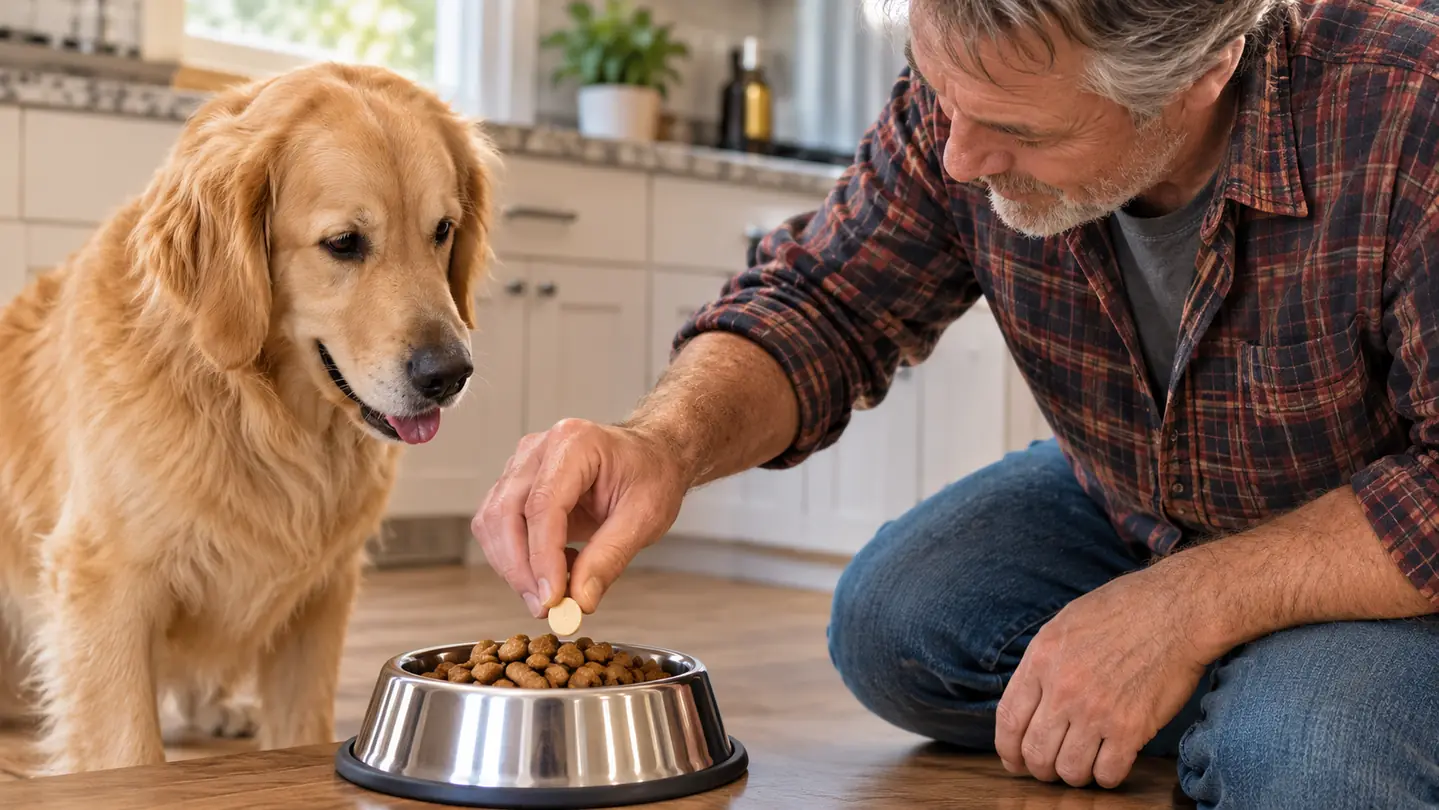
One practical note: these are chewable tablets, not liquid and not powder. Rusty is a medium-to-large dog, about 70 pounds, and he gets one tablet a day. The product is made for small, average, and large dogs, but the right dose for yours is a question for your vet, not a guess based on my dog. The tablets disappear into a bite of food, which matters for a dog who sniffs at anything new. Rusty sniffs everything before he eats it, so a tablet that vanishes into a mouthful of kibble saves us a daily argument.
Step 3: Give it the same way, at the same time, every day
Consistency matters more than perfection. We give Rusty his tablet with his breakfast every single morning, and I keep the bottle on the kitchen counter where I cannot miss it. If you have ever tried to remember a daily pill for yourself, you know how easy it is to forget by day three. Same time, same place, same routine is the whole trick. Our routine is boring on purpose. The bottle sits next to the coffee maker, so when Dale fills his mug at 7:15, the bottle is right there in his line of sight. On the mornings I feed Rusty before I have had my coffee, I say the routine out loud as I do it: tablet, kibble, bowl down, watch him finish.
Some dogs will take a chewable tablet right out of your hand. Rusty prefers his hidden in a small piece of his regular food, so I place it on top of his kibble and watch him eat it before I leave the bowl down. If your dog is picky, ask your vet whether it is okay to break the tablet or mix it with a little wet food. Never force a tablet into a dog's mouth, and never hide a supplement in food that you are not sure he will finish. We learned that one the hard way. In the first week, I put the tablet in his bowl and walked away to answer the phone, and when I came back the tablet was still sitting there on top of the kibble, untouched. Rusty had eaten around it. Now I stand at the bowl until I see him take it, which takes about thirty seconds and saves a lot of guessing.
Write the start date on the calendar. Our vet told us to give it six to eight weeks before judging, and I am glad we did, because the changes were gradual. If you expect a difference in three days, you will be disappointed. If you mark the calendar and stay consistent, you give the supplement a fair chance to do its job. I wrote January 14th on the kitchen calendar and circled February 25th, which was six weeks out. On the first of March I called the vet's office and left a note for her with what we had seen, and she called back the same afternoon. That check-in is worth doing, because it gives you a reason to pay attention to the small changes instead of just hoping.
Step 4: Pair the supplement with gentle daily movement
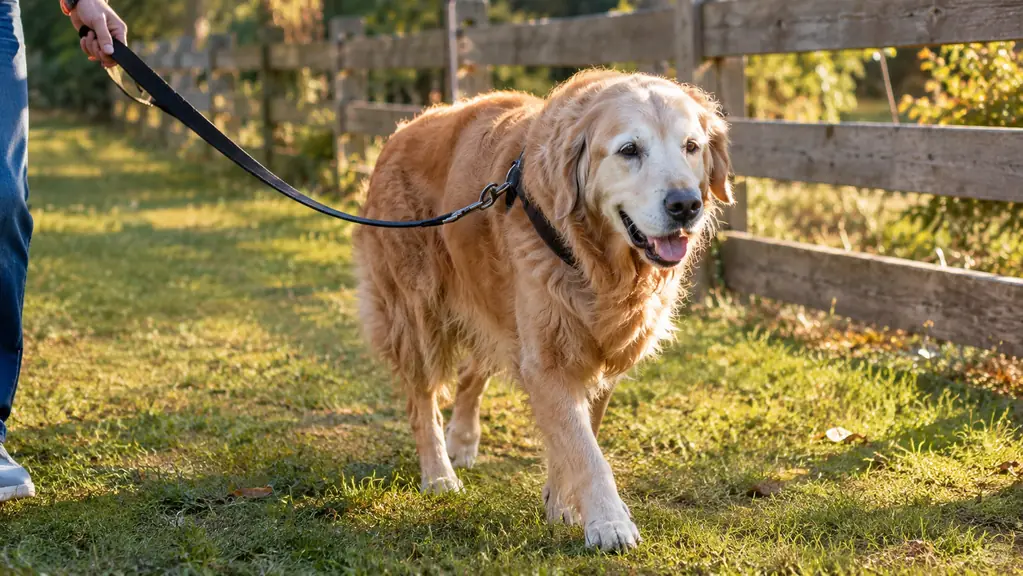
The supplement was never the whole plan. Our vet was clear that a senior dog with stiff hips still needs to move, gently and regularly. Rusty and I still do our 20 to 30 minute morning walk, but we changed the pace. We go slower, we let him set the route, and we turn back the minute he looks tired. Movement keeps his joints from locking up, but the walk is for him, not for my step count. The route changed too. We used to loop the block at a brisk clip, and now we take the long way down the alley to the grassy strip behind the school, where the ground is softer than the sidewalk. On the days I have my senior fitness class, we keep the walk to twenty minutes so he is not waiting too long for his breakfast.
Warmth helps too. On cool mornings, Rusty is stiffest right after he gets up, so we let him stretch in the kitchen for a few minutes before we head out. On really cold days, I shorten the walk and let him spend more time in the sunny spots of the yard. The routine matters more than the distance, and a short walk every day beats a long walk on the weekend. One morning in February it was 28 degrees and Rusty came to the back door, took one look at the frost, and turned around. I did not push it. We did ten minutes in the yard instead, and by the time the sun hit the patio he was moving better than he had all week. I have learned to let the weather and the dog decide the distance, and to save the long walks for the days he asks for them.
Step 5: Fix the floors, the bed, and the stairs
Here is what nobody tells you when you buy a joint supplement: the floor your dog walks on matters as much as the tablet he swallows. We have hardwood and tile in our one-story house, and Rusty's feet slide on both. We put down a few low-pile rugs on his favorite paths, and the difference in his confidence was immediate. He does not do the cautious shuffle on the way to his water bowl anymore. We bought runners for the hallway and a larger rug for the living room, and we used rubber rug pads underneath so nothing slides. It took one afternoon and made an immediate difference. If you cannot replace your flooring, a few well-placed rugs are the next best thing.
His bed got an upgrade too. Senior dogs with stiff hips need something they can sink into, with enough support to get out of easily. We chose an orthopedic bed with a low edge, and we put it in the warmest corner of the living room. The three steps down to the backyard are still his hardest move, so we added a ramp for the days he does not feel like stepping down, and we always walk beside him on the stairs. The ramp took Dale an afternoon to build out of a sheet of plywood and two lengths of 2x4, and it leans against the back step when we need it. Rusty used to stand at the top of the steps and whine until one of us came to help him down. Now he takes the ramp on his own most mornings, and he only uses the steps when he is feeling good.
Watch his weight as well. Extra pounds make every stiff joint worse, and our vet weighs Rusty at every checkup. The supplement supports his joints, but it cannot do its best work if he is carrying extra weight. If your dog is heavy, ask your vet about a sensible feeding plan before you add anything else to the routine. Rusty has stayed right around 70 pounds since he turned nine, and our vet says that is exactly where she wants him. We measure his food with the same cup every morning and evening, and treats come out of his daily allowance instead of on top of it. It sounds fussy, but it is easier than trying to take weight off an older dog later.
What Else Helps
A few smaller things made a real difference for us. We stopped calling Rusty to the back door from across the house, because a senior dog should not have to hurry on hard floors. We keep his nails trimmed short so his feet grip better on the rugs and the grass. We added a second water bowl in the living area so he does not have to walk to the kitchen as often. And we learned to read his signals: if he lies down and closes his eyes, the walk can wait. None of these things are dramatic, but together they made his days easier.
The other honest note is about expectations. Nutramax Cosequin helped Rusty, but it did not make him young again. He still naps longer than he used to, he still takes the ramp instead of the steps on some days, and he still has stiff moments when he first stands up. What changed is that the stiffness does not last as long, and he seems more willing to join me on the morning walk. That is the outcome we were hoping for, and it is the one I would tell you to expect: not a cure-all, just a more comfortable older dog.
After six weeks, Rusty still had stiff mornings, but he stopped hesitating at the back-porch steps, and that was enough for us.
Start the same routine tonight
Talk to your vet first, then pick up Nutramax Cosequin chewable tablets and mark your calendar for six weeks from today. The current price on Amazon is the only number you need to check before you decide.
Amazon Check Today's Price on Amazon →