
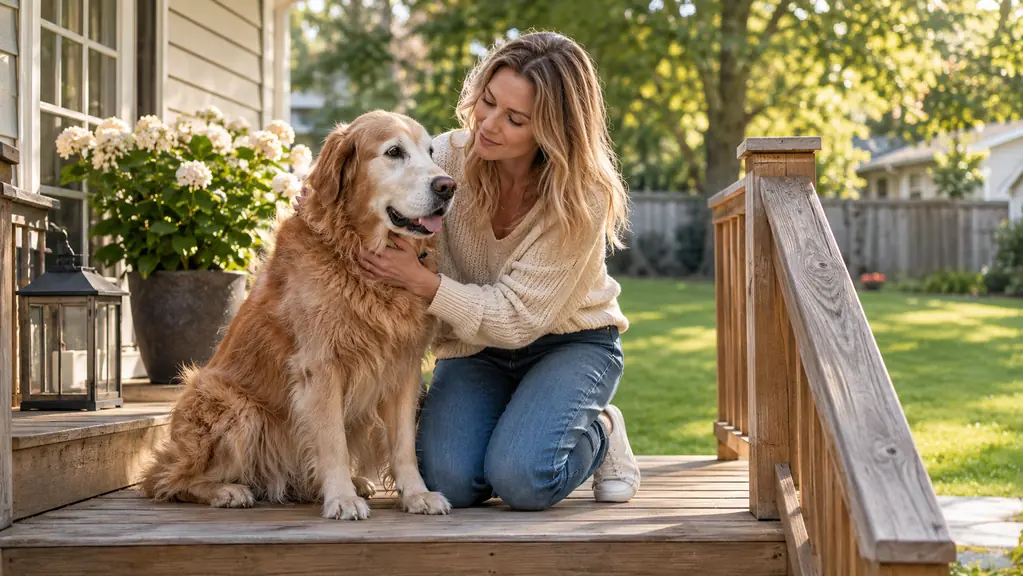
Rusty is an 11-year-old Golden Retriever, about 70 pounds, and for the past year the three steps down to our backyard have been the hardest part of his day. He still loves the morning walk, but after a nap his back hips are stiff, and those steps turn into a negotiation. I tried the things most owners try first. I carried him, until my own back complained. I thought about a ramp, but a ramp does nothing for getting into the car or onto the couch. I looked at carts, but he is too proud and too heavy for that. Then I found the LOOBANI Dog Lift Harness for Large Dogs, and it changed our mornings.
I am not a veterinarian, and I want to be clear about that before anything else. Before we used any kind of support or changed Rusty's routine, I checked with our vet, and I want you to do the same, especially if your dog has a diagnosed condition like hip dysplasia or arthritis. What I can offer is what works in our house: a one-story home with hardwood and tile floors, three steps down to the backyard, and a dog who is stiff but not ready to quit.
Give your senior dog back the stairs without giving up your own back
The LOOBANI lift harness supports weak rear legs so a senior dog can stand, climb steps, and get into the car without you bending over to lift. It is the tool we reach for every single morning.
Amazon Check Today's Price on Amazon →Why a Lift Harness Instead of Carrying
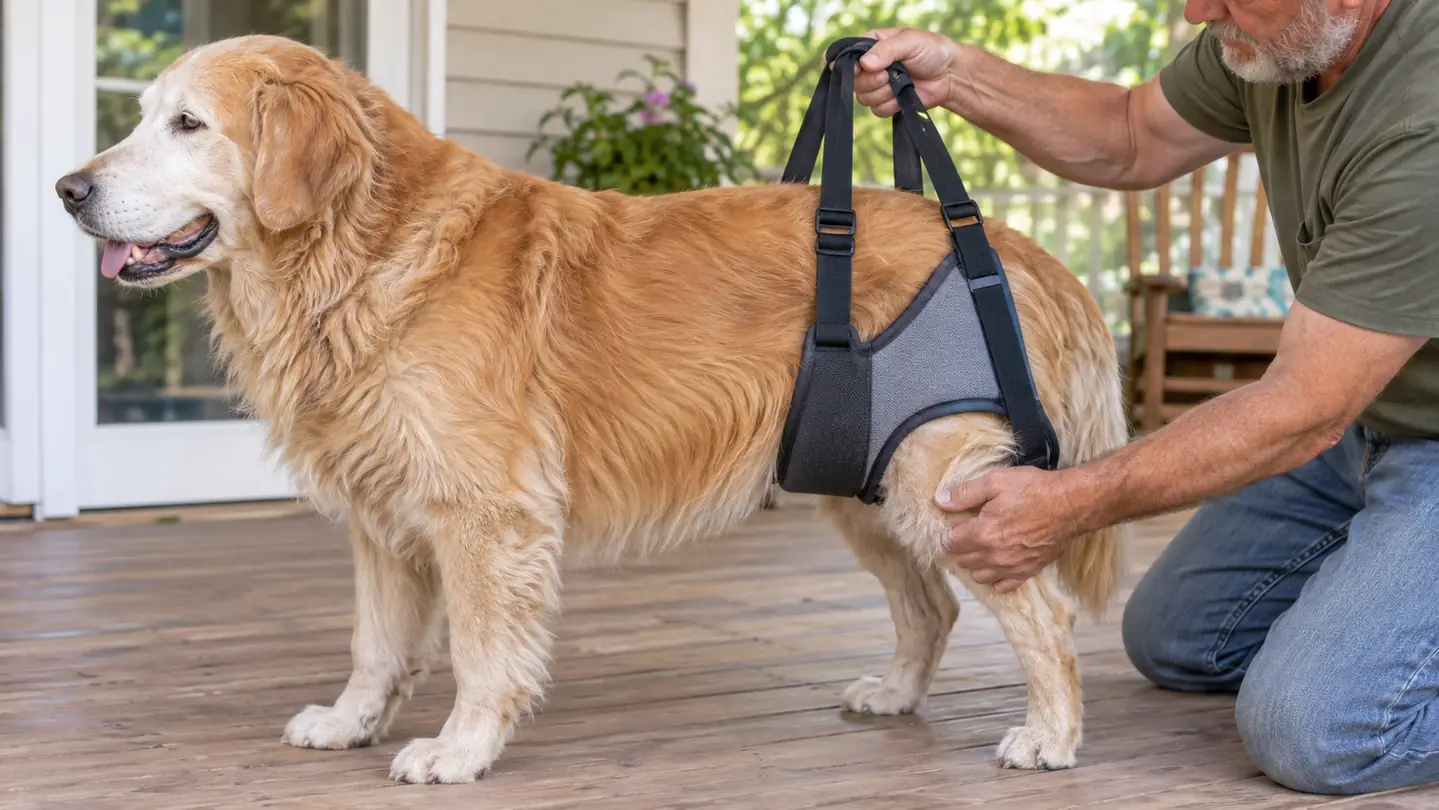
Carrying a 70-pound dog is not a long-term plan. It is hard on your back, hard on the dog, and dangerous on stairs if he squirms. A lift harness works differently. It supports the back half of the dog so his front legs do the walking and his rear legs do the resting. The LOOBANI version is a nylon sling that cinches with a drawstring and has a soft sheepskin-like lining against the belly. At 14.88 ounces, it is light enough to carry in the storage bag that comes with it.
The listing calls it a support hip sling for elderly dogs and weak hind legs, and that matches what I see every day. It helps Rusty stand up after a nap, walk up and down the back steps, get into the car, and step onto the couch. It is not a wheelchair and it does not do the work for him. It takes the edge off, so he can keep doing the things he wants to do.
I also chose it because it is simple. No complicated straps to figure out. The closure is a drawstring, the material is nylon, and when he gets muddy I machine wash it. When we are done, it folds into the portable storage bag and hangs by the back door. Simple tools get used. Complicated ones collect dust.
I will also say the obvious thing: an 11-year-old dog is not a puppy, and no harness will make him one. The goal is not to erase his age. The goal is to keep him comfortable and active for as long as we can. The LOOBANI does that by working with the body he has, not against it.
How I Use It, Step by Step
Here is the routine that works for us. It took a few tries to get it right, so do not be discouraged if the first walk is clumsy. Start slow, keep sessions short, and let your dog set the pace.
Step 1: Size It Correctly Before You Ever Put It On
The LOOBANI comes in sizes, and we use the X-Large, which is meant for large dog breeds. Rusty is about 70 pounds, and the X-Large fits him with room to cinch the drawstring. If your dog is between sizes, I would size up rather than down. A sling that is too tight will rub, and a sling that is too loose will not support anything.
Take the sling and the storage bag out of the box first, and read the included instructions. The harness is simple, but simple does not mean skip the directions. I also checked the sizing guidance on the Amazon listing before I ordered, because the right size is the difference between a tool that helps and a tool that annoys.
One more thing: the sling is machine washable, which matters more than you think. The first time Rusty wore it, he walked straight through a muddy patch in the yard. I tossed the sling in the wash, hung it to dry, and it was ready the next morning.
The storage bag is a small thing, but it matters. It keeps the sling clean in the car and easy to find at home. I keep ours on a hook by the back door, so the harness is always within reach when Rusty needs to go out. If the harness is hard to find, you will not use it.
Step 2: Practice on Flat Ground First
Do not start on the stairs. I put the harness on Rusty in the living room and let him walk around the hardwood floor with it for a few minutes. The first time, he walked funny, like he was not sure what was happening behind him. That is normal. Give your dog a day or two to get used to the feel of the sling before you ask for anything difficult.
To put it on, I hold the sling under his belly, back near his hips, and cinch the drawstring until it is snug. Snug means it stays in place without digging in. The soft lining sits against his skin, and I check that the sling is not twisted. A twisted sling will rub, and a rubbed belly is a good reason for a dog to hate the whole idea.
Walk him around the house with it on, but do not lift yet. Let him feel that the sling is just there, like a coat. The goal of this step is zero drama. If he is nervous, give him a treat and try again later. Patience here saves you from a dog who fights the harness every single morning.
Step 3: Add Gentle Support While He Stands
Once Rusty was comfortable wearing the sling, I started helping him stand up after naps. This is where the harness earns its keep. When he is lying down and stiff, I slide the sling under him, gather it in both hands, and lift just enough to take the weight off his back legs. He does the rest. He pushes up with his front legs, and I steady the rear.
The key word is gentle. You are not hoisting the dog. You are taking the edge off so his own legs can do the work. If you lift too much, the dog learns to go limp and let the harness do everything. If you lift too little, you might as well not have it. The right amount is the amount that lets him stand without struggling.
I use the same approach for the car. Rusty can no longer jump into the back seat the way he did at five. With the sling, he puts his front paws up and I lift his rear just enough to get him in. Same for the couch. It is not a full lift, it is an assist, and that is exactly what a senior dog needs.
Step 4: Take It to the Stairs, One Step at a Time
Now the real test: the three steps down to our backyard. I stand beside Rusty, on the side facing the house, with the sling gathered in one hand. He takes the first step with his front legs, and I support his rear just enough to keep his hips from dropping. Then the next step, then the next. We stop at the bottom, I give him a moment, and we do the walk.
Going up is the harder direction. The back legs have to push, and that is exactly where he is weakest. I keep the same rhythm: front legs step up, I lift the rear just enough to follow. If he stops halfway, we stop. I do not pull him up the steps. Pulling forward on a sling can put pressure in the wrong places, and a fall on stairs is the one thing I am trying to avoid.
Start with one or two steps, not the whole flight. Rusty got the hang of the three back-porch steps within a week, but I did not push it. Some mornings he is stiffer than others, and on those mornings we just wait. I let him stand at the top, stretch, and decide when he is ready. The harness is not a race.
Step 5: Make It Part of the Morning Routine
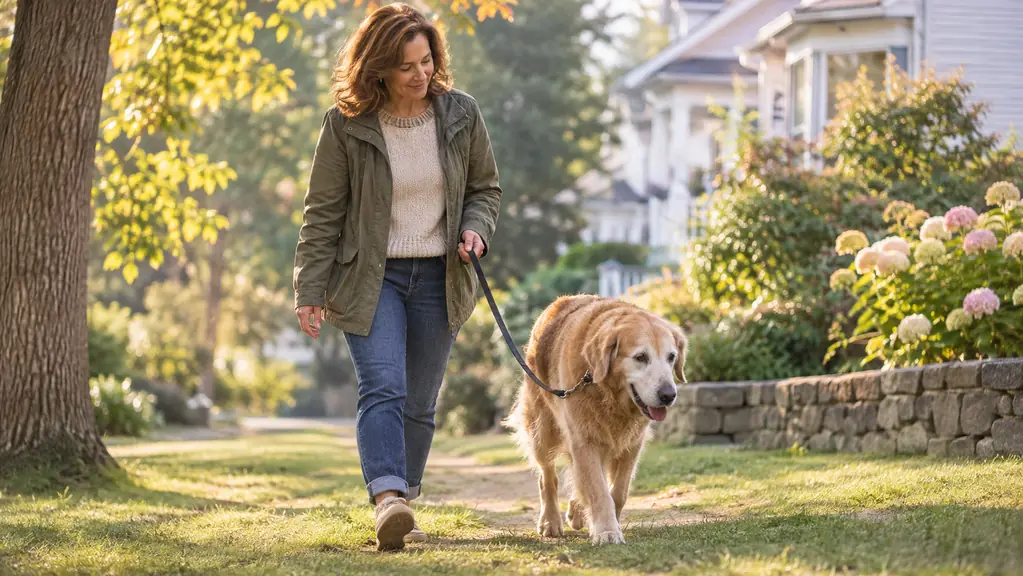
The thing that surprised me most is how quickly Rusty learned to like the harness. He now stands by the back door when he sees me pick it up, because he knows the sling means the walk. At 11, with stiff hips, he still gets his 20 to 30 minute morning walk, and that daily movement is the best thing we do for him.
After the walk, I fold the sling and put it in the storage bag that came with it. It hangs by the back door, ready for the next time. When it gets muddy, I machine wash it. The whole thing takes less than a minute, and because it is easy, I actually do it. That is the real test of any tool: do you reach for it every day? We do.
One honest note: the harness does not fix his hips. He is still stiff after naps, and some mornings are harder than others. What it does is let him keep living his normal life without me having to carry him and without him having to struggle. That is enough. That is the whole win.
The Honest Downsides
I want to be fair about the things that are not perfect. The LOOBANI is not a hands-free solution. You have to be there, holding the sling, every time your dog uses the stairs. It does not give him independence, it gives him assistance, and those are different things. If you are looking for something that lets your dog manage on his own, this is not it.
It also took Rusty a few days to accept it. The first time I put the sling on him, he stood perfectly still and gave me a look that said he was not impressed. I had to go slow, use treats, and keep the first sessions short. If your dog is sensitive about being touched around the belly, plan for a longer adjustment period.
And the X-Large, while right for Rusty, is not a one-size-fits-all answer. The sizing guidance on the listing exists for a reason. Measure your dog, read it, and if you are between sizes, ask the seller a question before you order. Getting the size wrong is the most common reason a harness like this ends up in a drawer.
What Else Helps
A harness is one piece of the puzzle. The rest of what we do is boring and effective. We put rugs on the hardwood and tile so Rusty does not slip. We keep his toenails trimmed short so he gets traction on the porch steps. He has a good thick bed in the living room, and he sleeps on it more than he used to. And we keep the morning walk gentle and regular, because a dog who moves a little every day stays mobile longer.
I would also say this: check with your veterinarian before you change anything, especially if your dog has a diagnosis like hip dysplasia or arthritis. I am not a vet. I am a dog owner who found a tool that works for us, and I want you to make your own decision with your vet's help.
One more habit that helped us: we stopped rushing. Rusty takes longer to get up, longer to get down the steps, longer to find the right spot in the yard. I build that time into the morning instead of fighting it. A senior dog does best when the humans around him are calm, and honestly, the slower pace has been good for me too.
Rusty used to sit at the top of the back steps and wait. Now he walks down them with the harness and me, one step at a time.
Give your senior dog more good mornings
The LOOBANI lift harness supports weak rear legs, helps with stairs, vehicles, and furniture, and folds into its storage bag when you are done. It has been part of our routine for months. See today's price on Amazon.
Amazon Check Today's Price on Amazon →