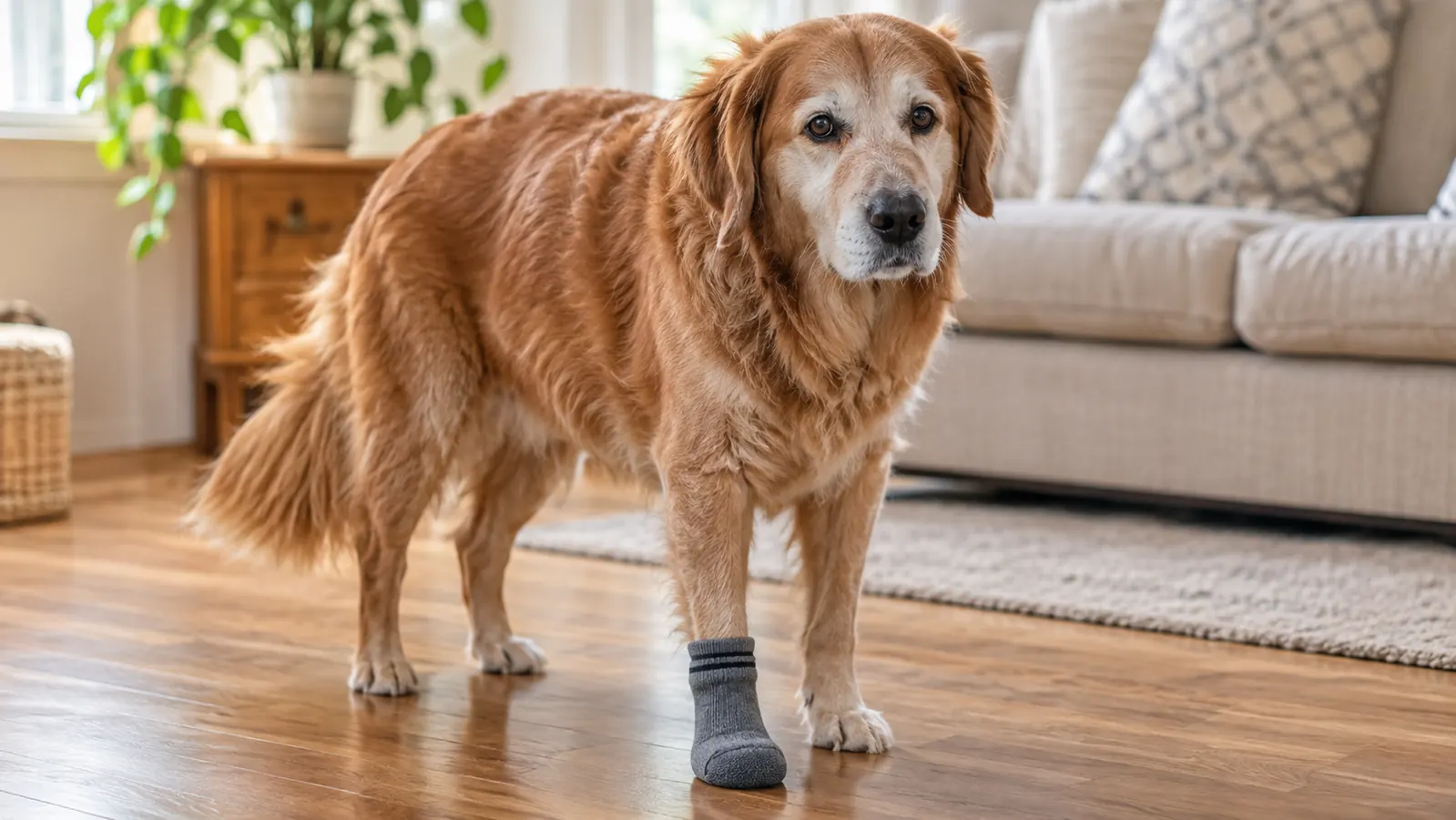
If you have an older dog and hardwood floors, you already know the sound. It is the sound of claws skidding, a hip dipping sideways, and a dog who used to trot now walking like the floor is made of ice. Rusty is an 11-year-old Golden Retriever, about 70 pounds, and after he naps he gets up stiff in the back hips. On our one-story house with hardwood and tile floors, that stiffness turns every turn into a slide. I spent months watching him, holding my breath, and wondering if there was anything I could actually do about it.
There is. After trying several options, I landed on a simple daily system built around a pair of DOK TigerToes Premium Non-Slip Dog Socks for Hardwood Floors. They are not a cure-all and they are not a substitute for a vet visit, but they fixed the sliding in our house within a week. This guide walks through the exact steps I use every morning and evening, the honest pros and cons, and what I would tell you if you were sitting at my kitchen table.
The socks that stopped the sliding in our house
The DOK TigerToes Premium Non-Slip Dog Socks are the ones I reach for every single day. Large size fits paws 2.5 to 2.8 inches, and you get four grip socks in the pack. Check today's price on Amazon and see if they fit your dog's paws.
Amazon Check Today's Price on Amazon →Step 1: Measure your dog's paw before you buy anything
The first mistake I made was guessing. I ordered a size I thought would fit Rusty, and the socks were too tight around his wrist. They slid off on the second walk. So before you buy, measure the widest part of your dog's paw, the part that sits right behind the toes. The DOK TigerToes Large size fits paws 2.5 to 2.8 inches, so that is the number you need to compare against.
Measure while your dog is standing, not lying down. A standing paw spreads out a little wider, and that is the size that matters when the sock has to stay on. I used a soft measuring tape and did it while Rusty was waiting for his breakfast, which is the only time he stands still for more than four seconds. If your dog is between sizes, go up. A sock that is slightly roomy will stay on better than one that is squeezing the wrist.
One more thing: the pack comes with four socks, which matters more than you think. You will lose one under the couch, one will be in the wash, and you still need two on the dog. Four is the right number for a daily routine, and it is one of the reasons I kept reaching for this brand.
Step 2: Start with the front paws only
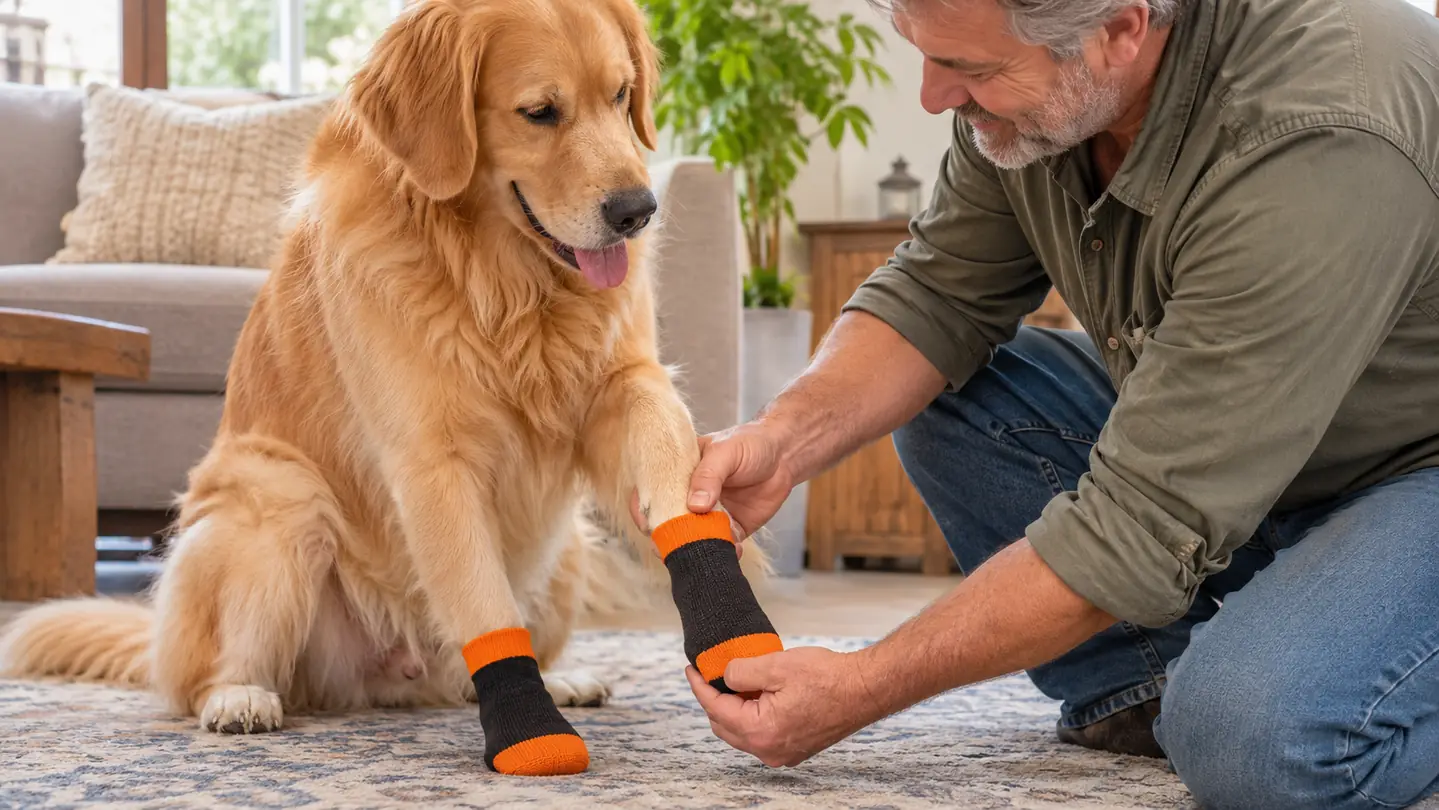
Here is the honest truth: most of the sliding happens in the front. A dog's front legs carry more of the weight, and on a slick floor that is where the feet skid out sideways. When Rusty first started slipping, it was always his front paws that gave way. So I started by putting socks on the front paws only, and the difference was immediate.
The DOK TigerToes socks have a performance grip that is engineered to provide reliable traction even if the sock twists while the dog is using them. That last part matters, because a sock that twists is a sock that fails. I have watched Rusty's socks twist halfway around his paw and the grip still held. The hook and loop closure at the top helps keep the sock in place, and the pull-on style makes it easy to get them on a dog who is not interested in cooperating.
Start with two or three short sessions indoors before you try a full day. Put the socks on, let your dog walk a few steps, and give them a treat for each step. Rusty looked at me like I had lost my mind the first time, but after three treats he decided the socks were fine. Within two days he was walking normally on the hardwood with the front socks on.
Step 3: Add the back paws once your dog is used to the front
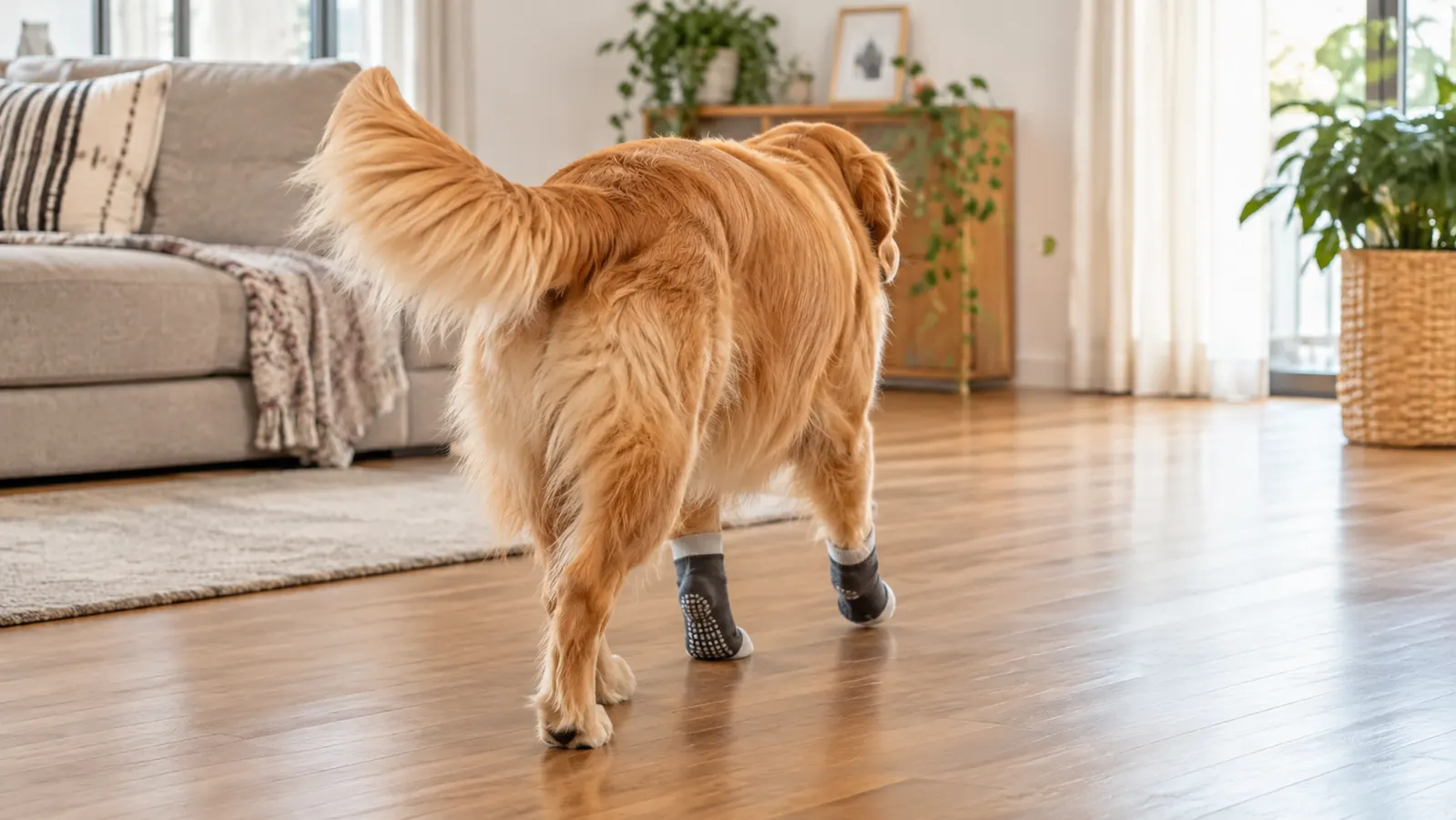
After about four days, I added the back paws. The back hips are where Rusty's stiffness shows up, and when those back feet slip, the whole back end drops. That is the moment that scared me most, because a hip that drops hard on a hardwood floor is how a senior dog ends up sore for a week. The back socks gave him the same traction as the front, and the difference in his walk was visible within a day.
The DOK TigerToes are specifically created with senior pet owners in mind, and I felt that in the details. The cotton and nylon material is soft enough that Rusty does not fight it, and the grip pattern covers enough of the bottom of the sock that he does not have to step carefully. He just walks, the way he used to before the floors got scary for him.
A note on timing: I do the back paws only for indoor time, and I take them off for the morning walk. The socks are recommended for indoor protection and outdoor protection, but on our porch and sidewalk they pick up dirt fast, and I would rather save them for the floors where the slipping happens. You may feel differently if you have a dog who needs the extra grip outside too, and the product is fine for that. It is just a choice about wear and tear.
Step 4: Build a daily rhythm instead of a one-time fix
The socks only help if they are on the dog. That sounds obvious, but it is the whole system. I keep the DOK TigerToes in a small basket by the back door, right next to the leash, so putting them on is part of the same routine as getting ready for the day. In the morning after Rusty's walk, I wipe his paws, put the socks on, and he has the run of the house without me following him around.
In the evening, I do the same thing after his dinner. The routine took about a week to become automatic, and now Rusty actually comes to me when he sees me holding the socks, because he knows what comes next. A senior dog does best with predictable daily movement, and the socks are part of that predictability. They are not a cage or a restriction. They are the thing that lets him move around the house the way he wants to, without me hovering.
Machine wash care makes the routine easy. I toss the socks in with the regular wash on a gentle cycle and let them air dry, and they come out looking the same as the day I bought them. I have been doing this daily for about two months now, and the grip still holds.
Step 5: Watch for the other places your dog slips
Once the hardwood was solved, I started noticing the other slick spots. Our three steps down to the backyard were the next problem. The socks helped on the steps too, but I also added a non-slip runner on the wood part of each step. That combination, sock plus runner, is what finally made the stairs safe for Rusty. If you have tile, the socks work there too, but I would still check for any area where a dog has to jump down, because a jump is a different kind of stress on the back hips.
DOK describes the TigerToes as multi-functional, suitable for large dogs, small dogs, and senior dogs, and providing paw protection for summer. That summer part is real: in the heat, the socks keep his paws off the hot parts of the patio while still giving him grip. I did not expect that to matter in Texas, but it does.
The bigger point is to look at the whole path your dog walks each day, not just the one room you noticed. A senior dog who feels sure on every surface will move more, and a dog who moves more keeps more strength in the back hips. That is the real win, and it is bigger than any single sock.
What Else Helps
The socks are the part of the system I reach for every day, but they are not the whole system. A good non-slip rug in the spots where your dog turns fastest helps more than you would expect. Trimming the hair between your dog's paw pads gives the grip more surface to hold. And if your dog is stiff after naps the way Rusty is, a gentle five minute walk before they get up from a long rest makes a difference. I am not a vet, and I always tell people to check with their veterinarian before starting any exercise change, especially with a diagnosed condition. For us, the socks plus a few small changes around the house meant Rusty stopped sliding entirely, and that let him keep moving the way an older dog needs to.
The DOK TigerToes Large fits paws 2.5 to 2.8 inches, and I have watched the grip hold even when the sock twists halfway around Rusty's paw.
What I'd Tell You If We Were Sitting at My Kitchen Table
If you were sitting at my kitchen table, I would tell you this: do not wait until your dog falls before you do something about the floors. I did, and I still wince when I think about the sound Rusty's hip made that one morning. The DOK TigerToes are not expensive, they are not complicated, and they worked within days for a 70 pound senior dog who had been sliding on our hardwoods for months.
I would also tell you to be patient for the first two or three days. Your dog will walk funny, the socks will come off a few times, and you will wonder if you wasted your money. That is normal. Give it a week, use treats, and build the routine. If the socks still do not stay on after that, measure the paw again and check the size. The Large fits paws 2.5 to 2.8 inches, and getting that fit right is the difference between a sock that works and a sock that ends up under the couch.
And if your dog has a diagnosed condition, or is showing new stiffness or pain, please call your vet before you change anything. I am not a vet, and I do not play one. What I can tell you is what worked in our house, with our dog, on our floors. That is the honest truth, and it is the only kind of advice I feel comfortable giving.
Give your senior dog sure footing today
The DOK TigerToes Premium Non-Slip Dog Socks for Hardwood Floors come in a pack of four, with a Large size that fits paws 2.5 to 2.8 inches. Check today's price on Amazon and see if they are the right fit for your dog.
Amazon Check Today's Price on Amazon →