
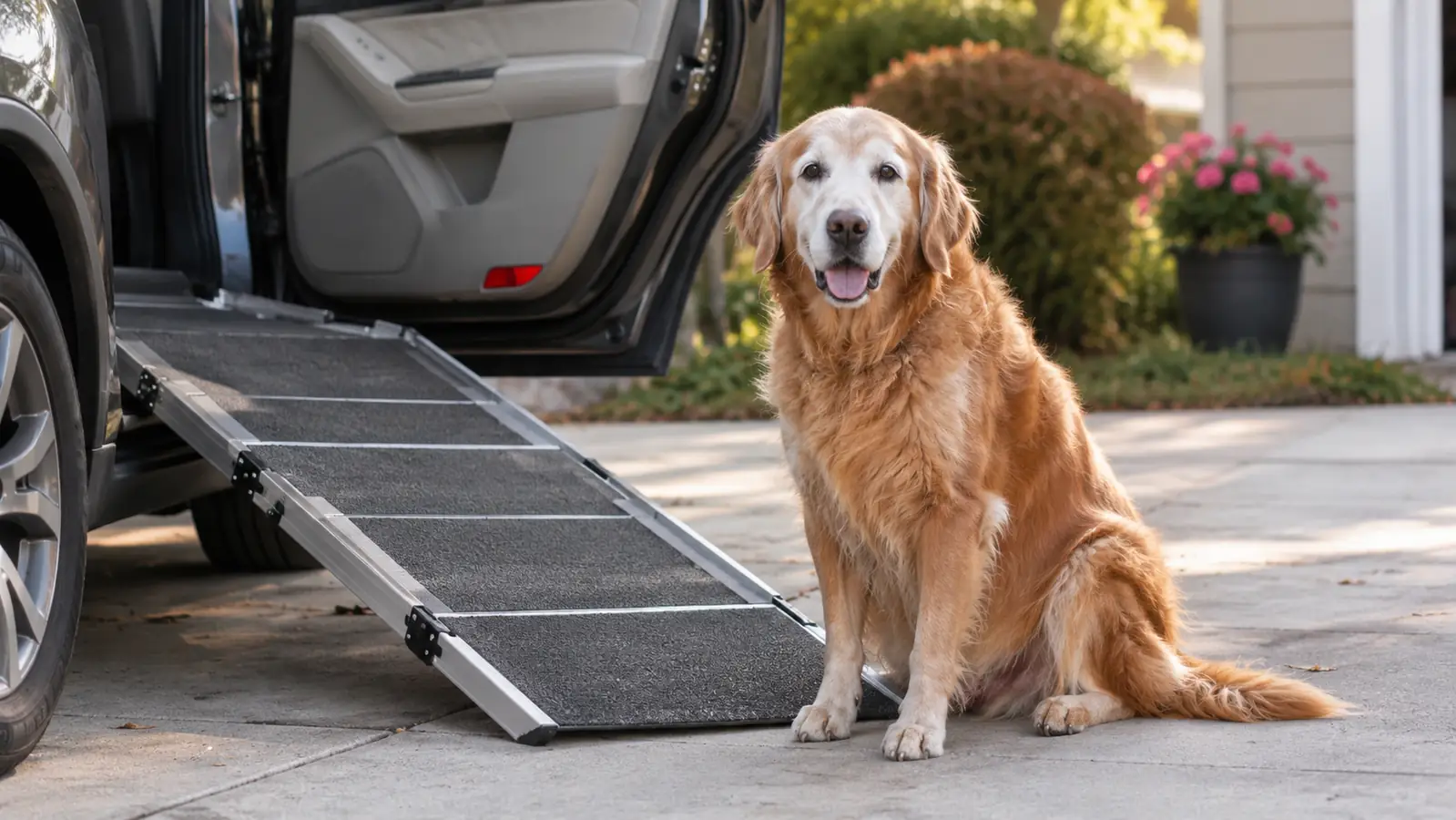
The back end went first. Rusty is an 11-year-old Golden Retriever, about 70 pounds, and for a while the only sign of age was the way he paused at the top of the three back-porch steps. Then came the morning he stood at the open car door and just looked at me. Not scared. Not stubborn. Just doing the math and deciding the jump was no longer worth it.
If that sounds familiar, the fix is not lifting your dog into the car until your own back gives out. The fix is a ramp, and the PetSafe Happy Ride Folding Dog Ramp is the one we landed on. But here is the part nobody tells you: a ramp only helps if your dog will actually use it. That is where the real work starts, and it is very doable if you go slowly.
Skip the Guesswork: Start With the Ramp That Fits a 70-Pound Senior Dog
The PetSafe Happy Ride Folding Dog Ramp is the one we use with Rusty. It folds flat, weighs 10 pounds, and carries up to 150 pounds. Before you start training, get the ramp in hand so the dog can sniff it, walk on it flat, and learn it is not a threat.
Amazon Check Today's Price on Amazon →Step 1: Let the Ramp Be Boring Before It Is Useful
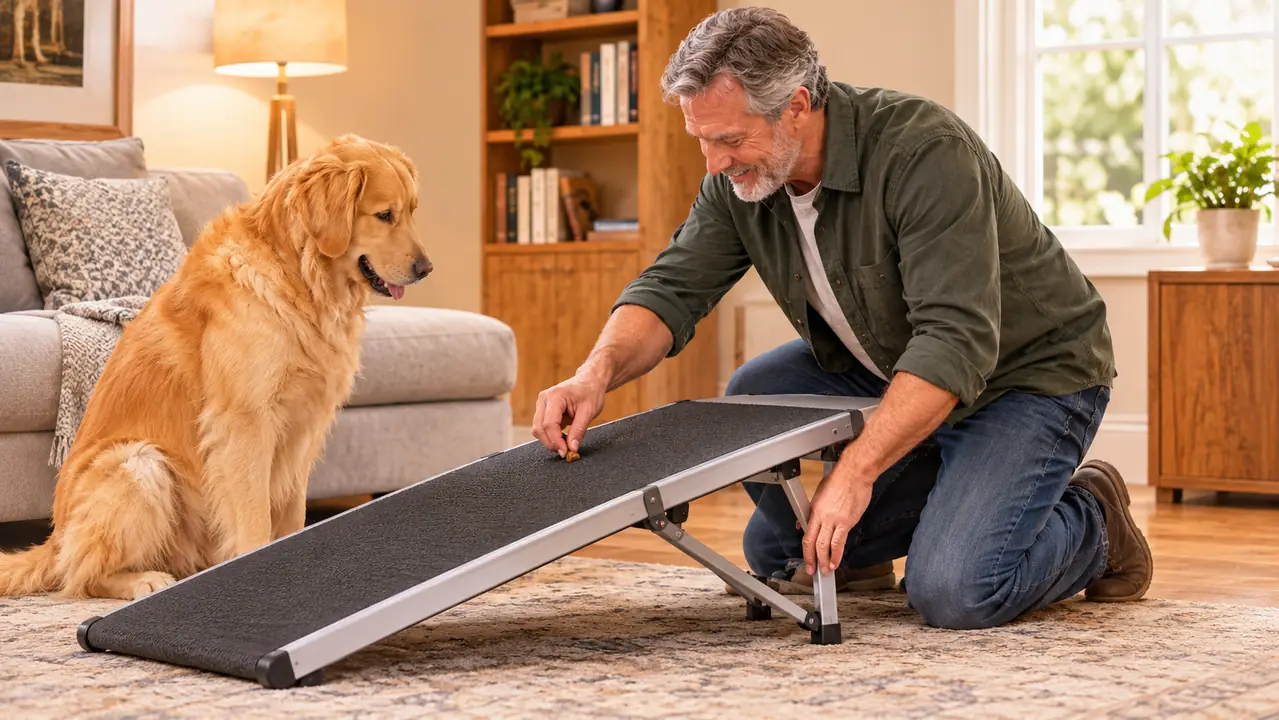
The biggest mistake I see owners make is propping the ramp against the car on day one and expecting the dog to walk up. A senior dog who is already nervous about jumping is not going to trust a narrow plastic plank on the first try. So we spent the first two days just letting the ramp exist in the living room. I picked the living room on purpose. It is where Rusty already feels safe, and the carpet gives his feet good traction while he figures out the texture of the ramp.
I set the PetSafe ramp flat on the floor, fully opened, with a couple of treats scattered along the surface. The first afternoon Rusty gave it a long look, walked a wide circle around it, then touched it once with his nose like it might bite back. I did not push. I sat on the floor beside it and let him decide. After a few minutes he stepped on with one front paw, and that was enough for day one. Day two he walked the full length for a piece of chicken. By day three he was stretched out napping on it. That is the goal of this step: the ramp becomes a familiar object, not a strange contraption. The high-traction treads gave him confidence even at this stage, because his feet did not slip.
Do this for a few minutes at a time, twice a day, and always end while he is still interested. If he walked the full length once, stop there and save the rest of the treats for tomorrow. Ending on a good note is what builds the habit. A dog who is relaxed on the ramp flat is a dog who will eventually trust it at an angle, and rushing that trust is the one thing that will set you back a week.
Step 2: Teach the Two-Feet-On Rule With a Low Step
Once Rusty was comfortable walking across the ramp on the floor, I moved it to the bottom step of the porch. The step is only six inches high, so the angle was gentle. I stood at the top with a piece of boiled chicken, said the word "yes" in the same bright tone I have used since he was a puppy, and waited. He put one paw on the ramp, then the other, and when both front feet were on, he got the treat. We repeated that little ritual maybe eight times over two days before he stopped looking for a shortcut.
The first session he tried to cheat. He put his front feet on the ramp and then hopped his back feet onto the porch step beside it, which is exactly the move that gets old dogs hurt. I did not scold him. I just took the treat away, walked him back to the bottom, and started over. It took three tries before he understood that the whole ramp, not just the top of it, was the path. The rule I used was simple: no treat until all four feet are on the ramp. No jumping onto the step beside it, no walking around the edge. The ramp has side rails that helped keep him centered, and the rubber feet held it steady on the concrete. When he figured out that the ramp was the only way to get the treat, he committed to it.
Keep these sessions to five minutes, and do two a day at most. Senior dogs learn best in short bursts, and an 11-year-old Golden does not need a forty-minute training marathon. His hips are stiffest right after a nap, so I scheduled our ramp work for mid-morning, after his walk and a drink of water, when he was loose and a little hungry. A dog who is tired or sore will not learn, he will just get frustrated, and frustration is the fastest way to turn the ramp into something he avoids.
Step 3: Raise the Angle One Step at a Time
The porch step was easy. The car is a bigger jump. The PetSafe Happy Ride measures 62 inches long and 16 inches wide, which means you can start at a shallow angle and gradually raise it as your dog gains confidence. That adjustability is the whole reason this ramp worked for us. With a shorter ramp you are stuck with one steep angle, and a steep angle is exactly what a hesitant senior dog will refuse. We also made sure the top end sat a few inches onto the seat rather than just at the edge, so it could not slide when Rusty put his weight on it.
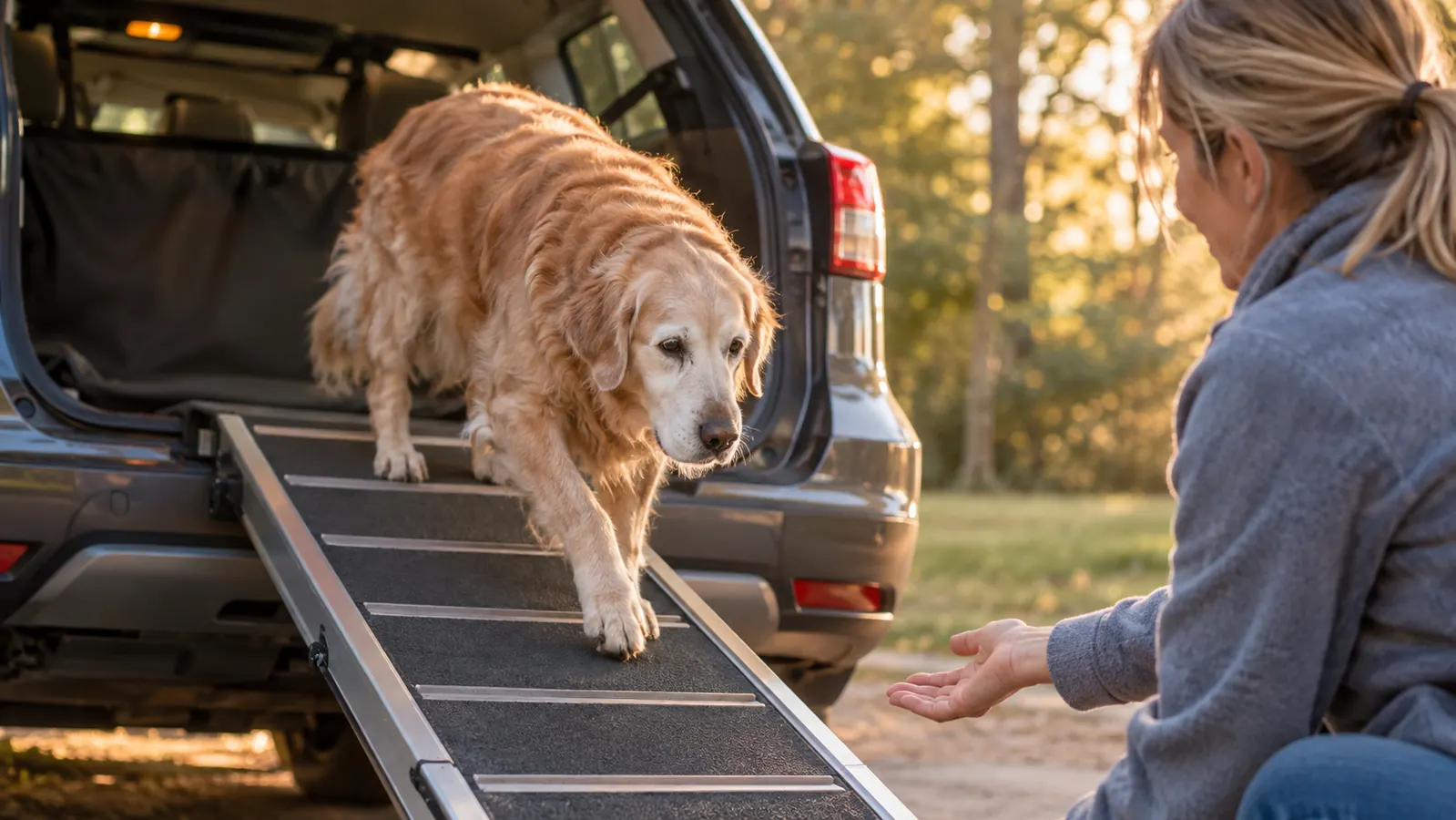
I started with the ramp resting on the floor of the back seat and the other end on the ground, which still gave a fairly gentle slope. The first time Rusty walked up and climbed in, I made a fool of myself clapping in the driveway. Then I put a folded towel under the lower end to raise it slightly, and over a week I removed the towel and let the ramp settle into its natural angle. Rusty did not even seem to notice the change, because by then the ramp was just the thing he walked on to get to the car. The morning he walked up without pausing, with the ramp at its full angle, I checked the date on my phone because I wanted to remember it: three weeks and two days after we started.
One caution: always check that the rubber feet are sitting flat before each use. On a slippery driveway or a wet morning, a ramp that shifts under the dog's weight will set your training back fast. I learned this the hard way when I set the ramp on a damp patch of concrete and Rusty took one step before the whole thing skidded an inch. He walked off and refused to try again for two days. We went back to the porch step, rebuilt his confidence, and I have checked the footing every single time since.
Step 4: Make the Car a Happy Destination, Not a Scary One
Most senior dogs do not fear the ramp. They fear what the ramp leads to. If the car only ever means the vet, your dog will learn to resist the ramp no matter how many treats you offer. So I made a point of taking Rusty to fun places during training.
For the first two weeks, every ramp session ended with a short drive to the park, a walk around the block, or even just sitting in the driveway with the windows down and a bully stick to chew. The car became the place where good things happen. By the time we actually needed to drive to the vet, Rusty walked up the ramp without hesitation because the ramp was the door to adventure.
This is also the step where you want to use the safety release latch. The PetSafe ramp locks into place when opened, and the latch releases it for folding. Getting into the habit of checking that latch before every use means you will never have a ramp collapse under a dog who is halfway up.
Step 5: Use the Same Ramp for the Couch and the Bed
The car was the hard part. The couch is the easy win, and it is where the ramp earns its keep every single day. Rusty has always loved curling up on the sofa next to Dale, but in the last year the jump up had become a struggle. He would pace in front of the couch, front paws up, back paws sliding on the hardwood floor. The ramp solves that with zero drama. The first time he used it on his own, I happened to be watching from the kitchen and I just stood there grinning.
I lean the PetSafe ramp against the couch at a gentle angle, and Rusty walks up it the same way he walks up the car ramp. The 16-inch width gives him room to center himself, and the high-traction treads keep his back feet from sliding when he pushes off. He uses it several times a day without being asked. That is the sign that training worked: the ramp is just furniture now. Dale and I used to brace ourselves every time Rusty gathered himself to jump onto the sofa, worried about his hips and our own backs. Now he just walks up, turns around twice, and settles in. It took about a week for the couch ramp to feel as normal to him as the car ramp, because the pattern was already in his muscle memory.
If your dog sleeps in your bed, the same ramp works there too. Just make sure the angle is not too steep. If the ramp looks like a ladder, your dog will make that calculation and decide the jump is still easier. The 62-inch length gives you room to find a shallower angle on most beds. Rusty does not sleep in our bed, but he does like to put his chin on the edge of it while Dale reads, and the ramp lets him do that without a scramble. When the ramp is not in use, it folds flat to 62 inches long, 16 inches wide, and only 4 inches thick, and it leans against the wall behind the armchair without being in the way.
What Else Helps
A ramp is not the only thing that made a difference for Rusty. We also put a nonslip rug runner on the hardwood hallway he walks every morning, because slippery floors are hard on stiff hips. He gets a shorter morning walk on the days he seems stiff, and we let him set the pace. And we talked to our vet about joint health before adding anything to his routine. If your dog has a diagnosed condition, check with your veterinarian before starting any new exercise or supplement plan.
The ramp itself is a 10-pound piece of plastic when folded, which means it is easy to carry to the car, the couch, or the back porch. The included rubber feet, the side rails, and the safety release latch are the features that make it feel solid. It is made in the USA, which mattered to me, and it comes with a 1 year warranty. Rusty has used it daily for months and it still feels as sturdy as the day we opened it.
The sign that training worked: Rusty walks up the ramp to the couch several times a day without being asked. The ramp is just furniture now.
Give Your Senior Dog the Gift of Easy Steps
The PetSafe Happy Ride Folding Dog Ramp is the same ramp we trained Rusty on, and it still looks and works like new. If your dog is hesitating at the car door, this is the ramp to try. Take the training slow, keep the treats coming, and let the ramp become the boring, reliable path to the places your dog loves.
Amazon Check Today's Price on Amazon →